
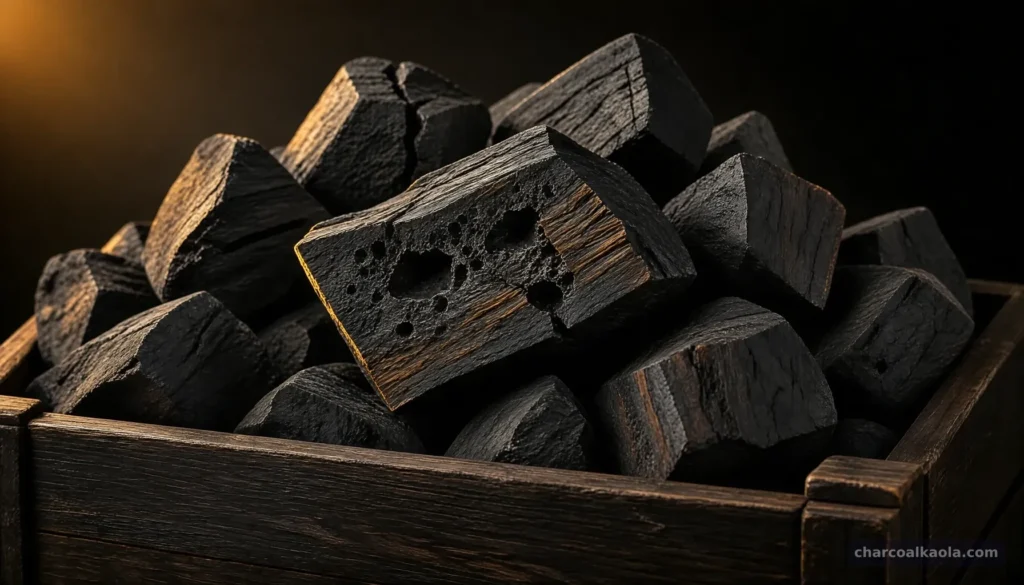
Hardwood lump charcoal wholesale gives restaurants a way to source natural wood charcoal in bulk for high-heat grilling, provided the fuel’s species, size range, moisture, packaging and shipment plan fit the kitchen. Vietnamese hardwood charcoal may suit steakhouses, barbecue restaurants and distributors, but “hardwood” alone does not guarantee consistent performance. Buyers should assess representative samples and agree on measurable specifications before placing a commercial order.
What hardwood lump charcoal offers a restaurant
Hardwood lump charcoal is made from wood carbonized into irregular pieces rather than formed with a binder into uniform briquettes. For restaurant buyers, the key question is not simply whether it is lump charcoal, but whether the selected material performs reliably in the restaurant’s grill and operating routine.
Why kitchens use lump charcoal
Lump charcoal is used in grills and other equipment designed for charcoal cooking. It can provide high heat and a wood-fired cooking environment, while the wood’s natural character may contribute flavor. Actual heat output, ignition behavior and burn duration vary with species, piece size, moisture, airflow, equipment and how the fuel is managed. Those variables matter in a commercial kitchen, where cooks need a repeatable service routine rather than a single impressive test burn.
For a restaurant group, evaluate fuel against the menu and equipment:
- High-heat searing: Check whether the grill reaches and sustains the working temperature your cooking process requires.
- Longer service periods: Assess how often staff must add fuel and whether the load lasts through a realistic service window.
- Flavor expectations: Test the charcoal with the foods and cooking method you actually use.
- Operational consistency: Compare several bags or samples, not just a few visually appealing pieces.
Lump charcoal has irregular shapes, so it generally does not stack or burn identically from piece to piece. That is a practical characteristic to account for when building a loading and replenishment routine.
Why Vietnamese supply can be relevant
Vietnamese suppliers offer several hardwood charcoal species and related charcoal products. Availability is not guaranteed by a product listing, however, and species should be confirmed by SKU and order. A buyer considering mangrove, eucalyptus, Khaya, longan or coffee charcoal should not treat those names as interchangeable: species, grading and intended application need to be specified.
KAOLA CO., LTD (CharcoalKaola) is a Vietnamese charcoal supplier with confirmed export experience in Australia and Taiwan. Its company information lists separate production locations and capacity figures for white charcoal and black charcoal; those figures are not interchangeable, do not establish current stock and do not guarantee an available production slot. The team’s experience preparing orders for export underlines a useful buyer principle: clarify product, packing and shipment requirements together, rather than choosing fuel on a product name alone.
What wholesale buyers should verify
A direct wholesale import magnifies small mismatches. A size range that works in one grill may obstruct airflow in another; excessive fines can complicate handling, while very large pieces may be inconvenient for a particular firebox. Agree in writing on the species, grade, piece-size distribution, fines tolerance, packaging and OEM requirements, and intended use.
Treat performance targets as targets unless they are supported by test results for the relevant sample or lot. For example, KAOLA’s mangrove figures are commercial targets, not guaranteed results for every shipment. A laboratory report for one product sample also cannot establish the composition of another species or automatically represent every future lot.
Compare specifications, samples and supply details
The most useful comparison is a product-and-order checklist, not a broad claim that one country or species is always superior; buyers comparing Vietnamese and Indonesian charcoal can use the same approach. Use the reference table below to identify what to request, what it tells you and how to interpret it.

A buyer’s reference table
| Item to compare | What to confirm | Why it matters |
|---|---|---|
| Product identity | Wood species, lump form and intended cooking use | Species and product form affect suitability; do not assume different hardwoods are equivalent |
| Piece-size range | Agreed dimensions or grading method | Pieces must fit the grill and support the kitchen’s airflow and replenishment routine |
| Fines tolerance | How fines are defined and the acceptable level | Excess fines can affect handling and the usable proportion of a load |
| Moisture | Test method, sample or lot reference, and agreed limit | Moisture uptake during storage can make ignition and heat less consistent |
| Ash and fixed carbon | Results tied to an identified sample or lot | These measures help compare tested material; they are not a substitute for a live cooking trial |
| Calorific value | Reported value, units and sample identity | Check units carefully and compare like with like |
| Burn performance | Trial conditions, grill type and piece size | Burn duration depends on fuel dimensions, airflow, ignition and equipment |
| Packaging | Bag or carton format, label details and any private-label requirements | Packaging affects storage, handling and the approved loading plan |
| Order quantity and loading | Quantity, packing configuration, pallets and container plan | Final loading depends on product density, grading, packing and route limits |
| Shipment terms | Port, Incoterm, freight, timing and required inspection | These are order-specific and should be settled in the quotation or contract |
| Documents | Applicable test, origin, transport and packaging documents | Requirements depend on destination, product, shipment and carrier |
How to interpret reported specifications
A test result is meaningful only when the product and sample are identified. KAOLA’s Vinacontrol report 23G15THQ02472-01 records results for a submitted white eucalyptus charcoal sample: ash 1.8%, fixed carbon 92.3%, gross calorific value 7,728 cal/g and sulfur 0.01%. Those values should not be presented as results for mangrove charcoal or as a guarantee for every lot.
For mangrove charcoal, KAOLA lists commercial targets of moisture below 5%, ash below 3%, fixed carbon at least 75%, calorific value 7,000–7,500 kcal/kg and a burn-time target of 3–5 hours. The burn time depends on charcoal size, equipment, ignition and airflow. Ask which measurements are available for the product and lot under consideration; do not infer unreported results such as volatile matter.
Compare landed supply, not just the product name
A workable wholesale comparison accounts for the whole order: packing, quantity, freight arrangements, shipment timing, inspection needs and destination requirements. Prices and payment terms are order-specific, so there is no reliable universal wholesale figure to apply across species, packing configurations and routes. Confirm MOQ, samples and any sample charges directly during the enquiry process.
Container-loading references should also be treated as planning estimates, not promises. KAOLA’s indicative references are about 13–14 MT of black charcoal in a 20-foot container and about 25 MT in a 40-foot container; final loading depends on density, grading, packaging, pallets, container and route limits. Do not apply these black-charcoal references automatically to white charcoal, briquettes or other products. For broader shipment planning, see this guide to hardwood charcoal export logistics and compliance.
How to qualify a wholesale charcoal order
A disciplined buying process moves from kitchen needs to sample evaluation and then to an order specification. This reduces the risk of approving a fuel that looks suitable but behaves differently in the restaurant’s equipment.
1. Define the restaurant’s operating requirements
Start with the equipment and service pattern. Record grill type, firebox dimensions, typical cooking temperatures, service duration, daily or weekly fuel use and the way cooks light and replenish the fire. Note whether the menu depends on intense searing, steady heat over a longer service, or a mix of both.
Then translate those needs into a supplier brief:
- Species or acceptable alternatives
- Piece-size range and grading
- Maximum acceptable fines
- Packaging and storage format
- Required test results or inspection process
- Intended shipment quantity and destination
Avoid requesting “premium hardwood lump” without defining what premium means for your operation. A supplier cannot reliably match a vague label to a specific restaurant workflow.
2. Request and assess representative samples
When samples are available, confirm the product identity and sample conditions before testing. Terms, including any charges, should be established during the enquiry. Evaluate several pieces and, where possible, more than one sample unit so the assessment reflects variation rather than a hand-picked lump.
Use the same grill, ignition method, loading approach and cooking tasks used in normal operations. Record time to usable heat, temperature behavior, smoke or odor observations during ignition, replenishment frequency, ash handling and performance through the planned cooking period. These are practical trial observations, not laboratory claims; record the conditions so another kitchen can repeat the test.
The CharcoalKaola Team’s export and product-enquiry work supports a simple lesson: a sample is most useful when the buyer already has a written specification and a repeatable evaluation plan.
3. Turn the trial into a written specification
After a successful trial, document the product and tolerances that were actually evaluated. Include species, size distribution, fines tolerance, packaging, order quantity and any sample or lot testing agreed with the supplier. If the charcoal is being considered for multiple restaurants, test it in a representative kitchen and confirm that the other sites use compatible equipment and procedures.
Make clear which measurements are binding requirements and which are monitoring information. For example, an agreed size range can be checked against incoming product, while a burn-time observation is meaningful only in relation to a specified setup. Ask how deviations will be identified and discussed before dispatch; do not assume every batch will be identical simply because the sample passed.
4. Confirm shipment and documents before committing
Before the order is finalized, confirm the quotation, payment terms, packing, port, Incoterm, freight responsibilities, production and shipment timing, and any inspection requirements. These details are negotiated per order. Do not assume a particular payment schedule, fixed lead time or universal acceptance of a payment method.
Check required documents against the product, packaging, carrier and destination. Transport, origin, test, inspection and packaging requirements can vary. For example, ISPM 15 requirements relate to applicable wood packaging, not automatically to every charcoal product or packing format. A certificate of origin associated with a qualifying shipment is not a company certification or an automatic guarantee of reduced duties. Buyers should verify current requirements with the relevant authorities and service providers.
Avoid common buying and kitchen mistakes
Wholesale performance depends on more than a laboratory number or supplier description. Proper trials, realistic specifications, safe kitchen arrangements and dry storage help prevent avoidable problems after delivery.
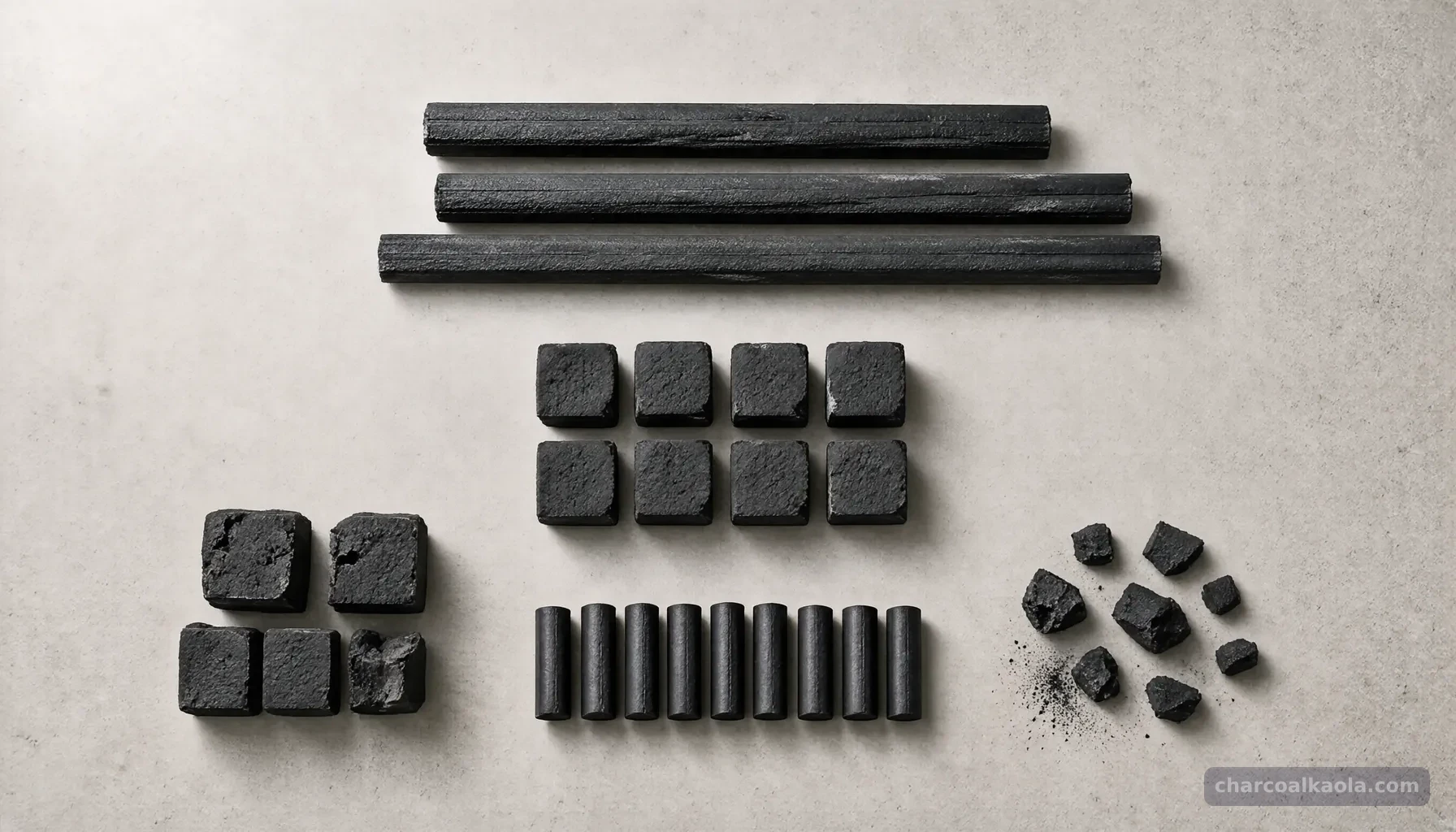
Common sourcing mistakes
Choosing by species name alone. Different woods and product forms should not be treated as equivalent. Specify the product, intended use and acceptable alternatives rather than assuming that all hardwood lump burns the same way.
Confusing targets with guarantees. Commercial targets and results for an identified laboratory sample have different evidentiary status. Ask whether a result applies to a particular sample, a tested lot or a general target, and do not extend it to another species.
Testing only a few ideal pieces. A small, selected handful may not represent a shipment. Assess multiple pieces, look for size variation and agree on a practical grading method before purchase.
Ignoring fines and packaging. A nominally suitable charcoal can be awkward to use if the size mix does not fit the firebox or the packaging is inconvenient for the receiving and storage setup. Include these details in the specification.
Assuming production capacity equals availability. Stated capacity is not on-hand stock or a reserved production slot. Confirm current SKU availability, quantity and timing for the order under discussion.
Kitchen ventilation and fire safety
Charcoal use in a commercial kitchen creates hazards that must be assessed independently of fuel quality. Carbon monoxide, smoke, sparks and grease-laden vapors can present serious risks. A restaurant should not assume that a charcoal grill can be installed or operated safely simply because the charcoal is suitable for cooking.
Before adopting charcoal, consult qualified local professionals and the relevant fire, building and health authorities. Commercial settings may require a Type I hood, fire suppression, spark arrestors and local approvals, depending on the equipment and jurisdiction. Requirements vary, so use the applicable local rules rather than a generic checklist as proof of compliance.
Train staff on the restaurant’s ignition, replenishment, shutdown and ash-handling procedures. Keep charcoal away from moisture and store it in a suitable, dry area. Never use a charcoal appliance where its manufacturer or local rules prohibit it, and maintain appropriate carbon-monoxide safeguards.
Storage, handling and consistency
Charcoal is hygroscopic: it can take up moisture from its environment. Store bags off the floor in dry conditions and protect them from water exposure. Moisture can make ignition and heat less consistent, so receiving procedures should include checks for damaged or wet packaging and a clear way to segregate affected stock.
Use a consistent stock-rotation approach and avoid opening more bags than the kitchen can store appropriately. On the cooking line, train staff to use a repeatable loading pattern and replenishment routine. Because lump pieces vary, cooks should learn how the selected size range behaves in the restaurant’s own firebox, rather than relying on a burn-time number without its test conditions.
Choose the right approach for each restaurant
There is no single lump-charcoal specification that fits every restaurant. Match the sourcing and trial process to the buyer’s scale, equipment and operating model.
Independent restaurant or first-time buyer
A single-site restaurant should begin with a clear equipment and menu assessment, then conduct a controlled sample trial. Focus on the details most likely to affect daily use: piece size, ease of loading, heat management, ash handling and storage. A sample that performs well for one shift is not necessarily proven for every menu item or a full service cycle, so test the actual cooking routine.
Keep the initial specification practical. Define the species, acceptable size range, packaging and any test information the restaurant needs to evaluate incoming stock. If a proposed alternative species is offered, treat it as a new product to qualify rather than assuming it will behave identically.
Restaurant groups and barbecue chains
For a chain, standardization matters as much as peak heat. Identify the grills and operating procedures used across sites, then determine whether a representative location can serve as the testing site. If equipment differs substantially, test in more than one configuration or define which sites the approved product is intended to serve.
Create a shared acceptance specification and a record for sample and incoming-product checks. Include a process for communicating changes in product, grading or packing before they affect multiple restaurants. Forecasting requirements and confirming production and shipment timing are especially important for a multi-site rollout, but neither capacity figures nor a previous order should be treated as a guarantee of future availability.
Importers, distributors and foodservice buyers
Distributors should distinguish between the charcoal’s end use and its resale description. Restaurant clients may need different size distributions, packaging formats and documentation, even when they are buying the same broad category of hardwood lump charcoal. Establish what information can be supported for each product and avoid making blanket claims about laboratory results, sustainability, food safety or regulatory approval without relevant evidence.
Private-label packaging and OEM options can be discussed as part of an order, but the label should accurately identify the product and avoid unsupported claims. For import planning, clarify destination-specific documentation and inspect the final shipping plan with the relevant parties. Buyers considering white charcoal rather than black hardwood lump can consult this Binchotan wholesale guide; the product type and intended use should not be confused with ordinary restaurant lump charcoal.
FAQ
Is hardwood lump charcoal suitable for every restaurant grill?
No. Suitability depends on the grill’s design, firebox size, airflow, operating procedure and local requirements. The charcoal’s species, piece-size distribution and moisture also affect practical handling and performance. Test a representative sample in the intended equipment and cooking routine before standardizing it across a kitchen or restaurant group. Separately confirm that the installation and operation meet applicable fire, ventilation and health requirements.
What specifications should a wholesale buyer request?
At minimum, identify the wood species, product form, piece-size range, fines tolerance, packaging and intended use. Ask which moisture, ash, fixed-carbon or calorific-value results are available and whether they relate to an identified sample or lot. If burn performance matters, request the trial conditions too; burn time varies with piece size, ignition, equipment and airflow. Agree which details are acceptance requirements and record them in the order specification.
Does a supplier’s stated capacity guarantee stock or delivery timing?
No. Capacity describes a stated production capability, not available inventory, a confirmed production slot or a guaranteed shipment date. Availability and timing must be confirmed for the specific product, quantity, packing plan and order. Buyers should also settle the destination, port, Incoterm, freight responsibilities, inspection needs and required documents before finalizing an order. Treat all shipment timing as order-specific and confirm it in the commercial documents.
Can a laboratory report for one charcoal sample be applied to another species or shipment?
Not automatically. A report applies to the sample and product identified in that report; it does not establish results for another species or every future lot. For example, reported white eucalyptus sample results should not be represented as mangrove results. Ask the supplier to identify the sample, test scope and available lot documentation, then decide whether further testing or inspection is necessary for your purchase and destination requirements.
