White charcoal vs black charcoal comes down to the job: white charcoal, commonly called Binchotan, is the better fit for cooks who need long, steady, high-temperature grilling with little smoke or flare-up. Traditional black charcoal, including hardwood lump charcoal, is usually easier to light, less expensive, and more practical for everyday grilling or heating. Their production, burn behavior, and handling differ, so the best choice depends on your equipment, budget, and cooking routine.
What White Charcoal and Black Charcoal Actually Are
White and black charcoal are both made by carbonizing wood, but they are produced and finished differently. Binchotan is a high-temperature charcoal; traditional black charcoal is carbonized at lower temperatures and is generally softer and easier to ignite.
Carbonization and the white ash coating
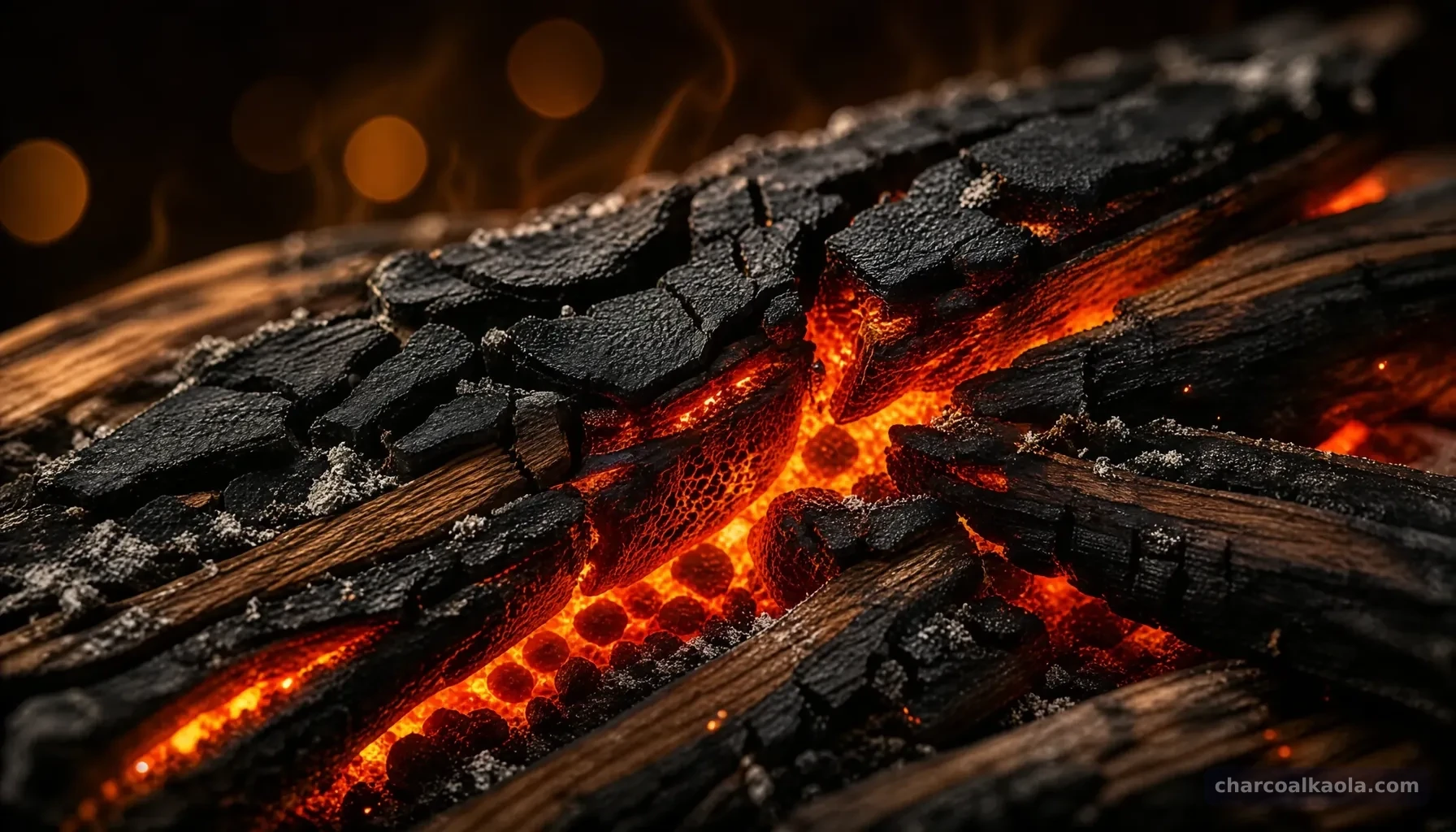
Traditional black charcoal is typically carbonized at approximately 400°C–700°C. This leaves it relatively soft, with more volatile organic matter than high-temperature white charcoal. It is commonly used as a general-purpose fuel because it tends to catch fire more readily.
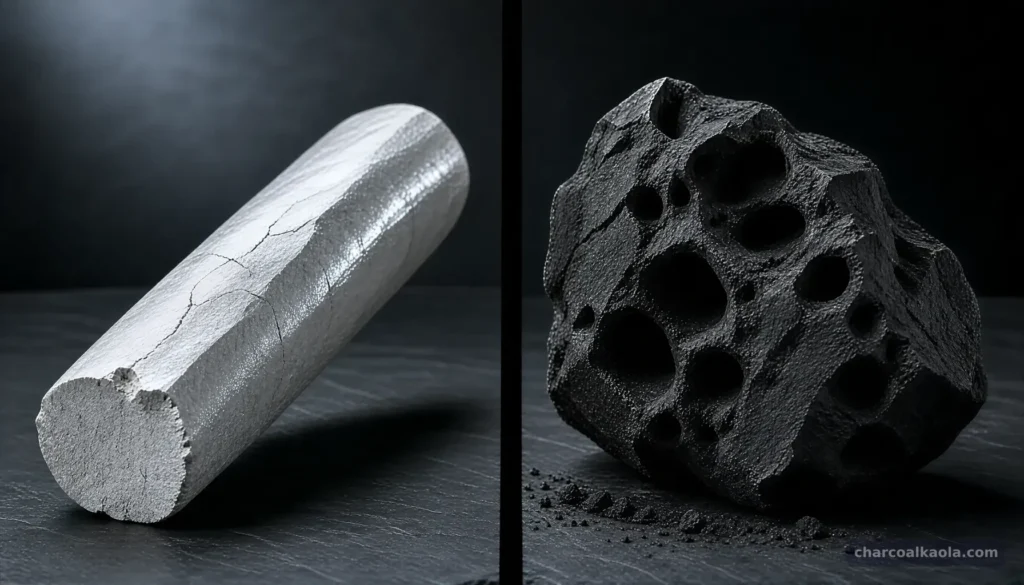
White charcoal, or Binchotan, is carbonized at approximately 1,000°C–1,200°C. During production, it is rapidly cooled by covering it with a mixture of earth, sand, and ash. The pale surface coating left by this process explains the name “white charcoal”; it does not mean the material inside is white.
These temperatures describe the production approaches in the comparison, not a verified specification for every product sold as white or black charcoal. Species, kiln conditions, production methods, and grading can affect the finished fuel. When evaluating a Vietnam charcoal manufacturer, buyers should ask for product-specific information rather than assume that every batch follows an identical process.
Structure, hardness, and the sound test
Binchotan is notably hard and dense. A traditional way to distinguish it from softer charcoal is to tap two pieces together: high-quality Binchotan may produce a clear, metallic-sounding ring. This is a quick screening clue, not a laboratory test or proof of species, origin, purity, or performance. Shape, cracks, and how the pieces are struck can all affect the sound.
Black charcoal is generally softer and breaks more easily. Its more open, porous structure is associated with adsorption uses in some charcoal products, but that does not make ordinary barbecue charcoal equivalent to activated charcoal or an approved water filter. Product form and intended use matter: fuel charcoal should not be assumed safe or suitable for drinking-water treatment.
Fixed carbon is not the whole buying decision
White charcoal often has a higher fixed-carbon content than traditional black charcoal; the supplied comparison facts describe Binchotan as often exceeding 90%. That figure is a general characterization, not a guaranteed result for every product. A valid comparison requires laboratory results tied to a named sample or lot.
For example, a Vinacontrol report for one sample of white Eucalyptus charcoal recorded 92.3% fixed carbon. That result applies to the submitted sample, not to every Eucalyptus product or every type of Binchotan. Fixed carbon can help buyers assess fuel characteristics, but it does not by itself tell you how easily the charcoal will light in your setup or how much usable heat you will get in practice.
How They Perform at the Grill
For grilling, the main practical differences are ignition, heat duration, smoke, and how much attention the fuel requires. White charcoal tends to suit controlled, sustained cooking; black charcoal is more convenient when fast startup and straightforward use matter more.
Ignition and heat-up time
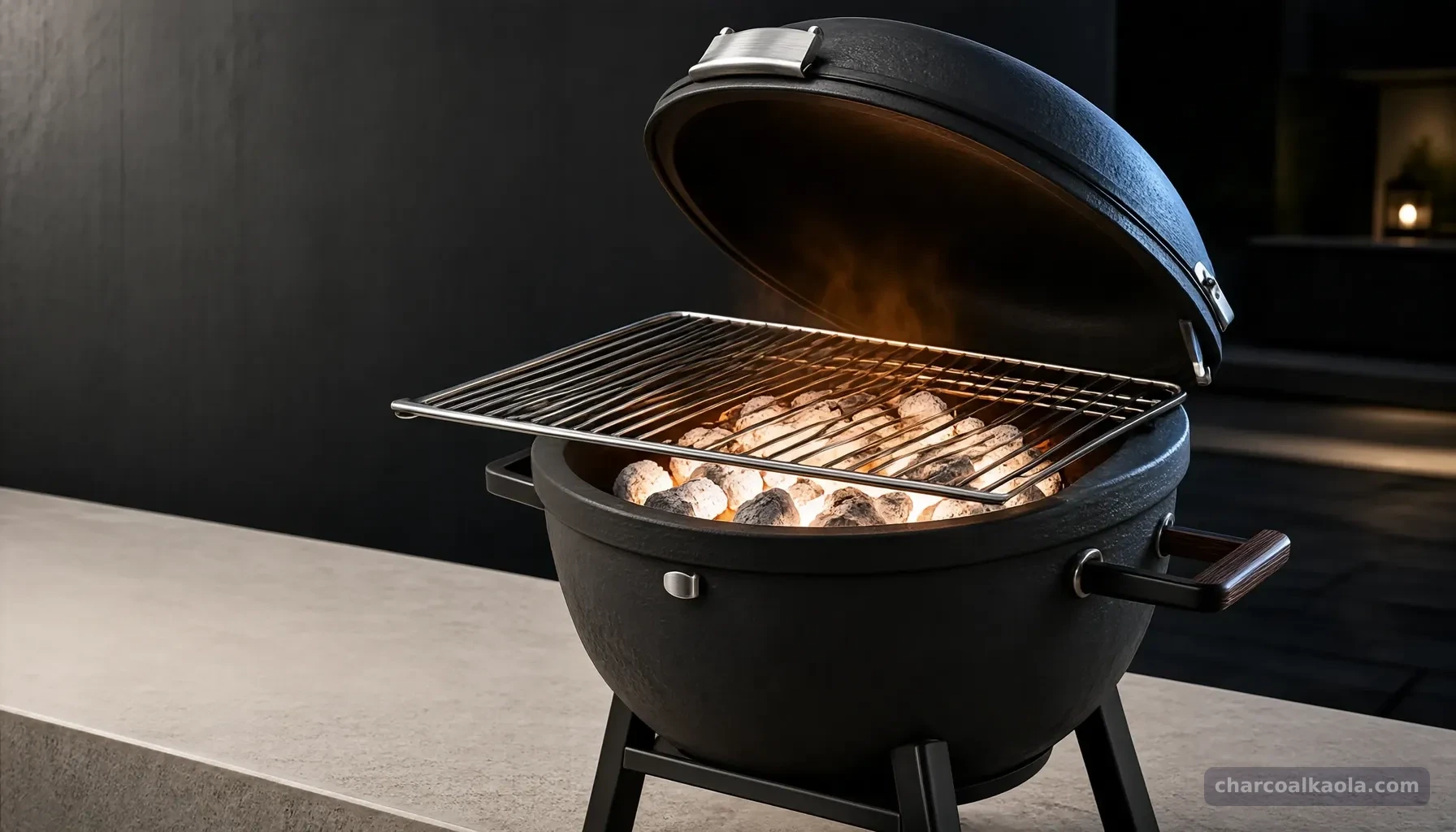
Black charcoal generally ignites more quickly and easily. That makes it a sensible choice for home cooks who want to start a grill without a long preheating period. It is also more forgiving when the user has a basic grill or limited experience managing a high-heat fire.
Binchotan is notoriously difficult to light by comparison. It needs a sustained heat source, such as a chimney starter or gas burner, and may take longer to reach a consistent glow. A useful operating sequence is to ignite it with the appropriate equipment, wait until the pieces are glowing red evenly, and only then begin cooking. If the charcoal is still unevenly lit, the cooking temperature may be inconsistent.
That extra preparation is a real trade-off, not a minor inconvenience. For a restaurant that runs a grill continuously, investing time in a stable bed of embers may make sense. For a quick weeknight meal, black charcoal is often the more convenient fuel.
Burn time, temperature, and cooking control
The comparison facts give a typical burn-time range of 3–5 hours for white charcoal and 1–2 hours for black charcoal. Treat these as general estimates, not guaranteed runtimes. Actual burn time depends on piece size, airflow, equipment, ignition, and operating conditions.
White charcoal is described as burning at a higher temperature and with less smoke and odor than traditional black charcoal. Its steady heat and infrared radiation make it useful for grilling applications where cooks want to sear food while cooking it through. In professional settings, Binchotan is associated with yakitori grilling and other high-heat cooking.
Black charcoal can be a better fit for lower-temperature cooking and general heating, especially when frequent additions of fuel are acceptable. A shorter burn may be less economical for a long service, but can be perfectly adequate for a brief cook. Match fuel to the cooking duration and grill design rather than relying on burn-time claims alone.
Smoke, flare-ups, and food handling
White charcoal is valued for producing minimal smoke and odor during use and for a steady cooking bed with fewer flare-ups. That can help cooks manage food over intense heat, but it does not remove the need for ventilation, safe handling, or control of cooking temperature. “Minimal” should not be read as “smokeless” under every condition.
Traditional black charcoal is a familiar option for everyday grilling, but its combustion characteristics and the grill setup can produce more smoke or flare-ups. Fat dripping onto embers, restricted airflow, and how the fire is managed all influence what happens at the cooking surface.
Neither fuel guarantees a particular flavor. Wood species and cooking conditions may influence the experience, but buyers should be cautious about broad promises that a charcoal will always be odorless, spark-free, or impart a specific taste. For restaurants, trialling a sample in the actual grill and menu workflow is more informative than comparing marketing language.
Ease of Use, Safety, and Other Applications
Black charcoal is generally easier to start and handle as a general-purpose fuel, while Binchotan demands more preparation and careful heat management. Their applications should be distinguished from those of activated charcoal, which is a specially processed adsorbent rather than simply another name for grilling charcoal.
Starting, maintaining, and extinguishing the fire
For Binchotan, use a suitable sustained heat source and allow the pieces to develop an even red glow before cooking. Because the fuel is dense and takes longer to ignite, build preparation time into the cooking schedule. Keep the grill in a suitable, ventilated setting and use equipment designed for charcoal cooking.
Black charcoal is often the more accessible option for users who want a quicker start. Its softer pieces may also be easier to break or size for a particular fire bed. This convenience does not mean it can be handled casually: charcoal produces dangerous carbon monoxide, so it must never be burned in an enclosed or poorly ventilated space.
Follow the grill manufacturer’s instructions for ignition, cooking, and disposal. Do not assume that a charcoal can be reused safely without checking that it is fully extinguished and that the equipment permits reuse. Keep hot pieces away from combustible materials and allow them to cool completely before disposal.
Fuel charcoal is not activated charcoal
The word “charcoal” covers products with different processing and intended uses. Activated charcoal is made by heating a carbon source and then exposing it to oxidizing gases such as steam or air at high temperatures. This activation creates a network of pores and a large surface area that can adsorb certain substances.
That is different from saying that ordinary black barbecue charcoal is an activated filter medium. Activated charcoal is used in some water and air filtration systems, and in specific clinical contexts; its performance depends on the material, activation, formulation, and application. Fuel charcoal should not be promoted or used as approved drinking-water filtration media without relevant evidence.
Activated charcoal is also not a general-purpose detox product. In emergency toxicology, it is used by medical professionals for certain ingestions, but it is ineffective for some substances and can pose risks. It can also bind medications. Anyone dealing with a suspected poisoning should contact emergency services or a poison-control professional rather than trying to administer charcoal at home.
A simple metallic sound test—and its limits
To try the traditional sound check, gently tap two dry pieces together and listen for a clear, ringing tone. A metallic sound is consistent with the hardness often associated with Binchotan, whereas softer black charcoal is more likely to make a duller sound or chip. The test is useful as a quick observation when examining samples, but it cannot establish product identity on its own.
Do not use sound to replace documentation, a representative sample, or a controlled cooking trial. Pieces may sound different because of size, shape, cracks, moisture, or how they are struck. For a commercial purchase, compare samples under the intended operating conditions and request relevant product and test information for the specific material offered.
Cost, Value, and Choosing a Supplier
Binchotan generally costs more because its production is more demanding and it is associated with specific wood types and high-temperature processing. Black charcoal is typically the more budget-friendly and accessible option, but the best value depends on usable cooking time, start-up needs, and the consistency required.
Comparing purchase price with operating value
There is no single reliable price that applies to all white or black charcoal. Species, grade, piece size, origin, packaging, order volume, freight, and delivery terms can change the final cost. For that reason, a useful comparison should be based on written quotes for equivalent quantities and specifications, rather than a generic price-per-kilogram claim.
For longer grill sessions, a longer-burning fuel may reduce how often the cook needs to replenish the fire. That advantage should be weighed against a higher purchase price and the extra time or equipment needed to ignite Binchotan. For occasional short cooking sessions, black charcoal’s lower entry cost and quicker startup may deliver better practical value.
Ask suppliers to make the comparison concrete:
- What wood species, product form, and grade are being offered?
- How are piece-size distribution and fines handled?
- What is the quoted price, packing format, and order quantity?
- Are the figures based on a specific sample or lot?
- What are the applicable freight, port, and delivery terms?
- Can the sample be tested using the buyer’s actual grill and operating routine?
No fixed burn time, carbon percentage, or market price should be treated as universal unless the supplier supports it with evidence relevant to the offered product.
Pros and cons of white charcoal (Binchotan)
Pros
- Can provide a sustained, high-temperature cooking bed.
- Typically burns longer than traditional black charcoal, subject to conditions.
- Produces minimal smoke and odor compared with black charcoal in the stated comparison.
- Its hardness and possible metallic ring provide a useful, though non-conclusive, sample-screening clue.
- Suits professional grilling where steady, intense heat is valuable.
Cons
- More difficult and time-consuming to ignite.
- Usually more expensive because of its production process and material requirements.
- Needs appropriate ignition equipment and a planned preheating period.
- A sound test cannot authenticate the product or confirm laboratory performance.
- Its benefits may not justify the added cost and preparation for brief, casual cooking.
Pros and cons of black charcoal
Pros
- Generally ignites more quickly and easily.
- Typically costs less than Binchotan.
- Works for general-purpose heating and lower-temperature cooking.
- Its softer texture can make pieces easier to break or adjust for a fire bed.
- Often suits home users who prioritize simple preparation over a long, controlled burn.
Cons
- Typically burns for less time than Binchotan, according to the comparison ranges.
- May require more frequent fuel additions during extended cooking.
- Is softer and less dense than Binchotan.
- May produce more smoke or odor depending on the charcoal and conditions.
- Ordinary black fuel charcoal is not the same as activated charcoal and should not be treated as a filtration product.
A practical buyer decision framework
Choose white charcoal/Binchotan when:
- You run a restaurant or grill that benefits from a sustained, high-temperature cooking bed.
- Longer burn time and reduced smoke or odor are important to your workflow.
- You can accommodate slower ignition and have suitable equipment.
- Your trial confirms that its performance offsets its higher purchase cost.
Choose traditional black charcoal when:
- You want fuel that is generally easier to ignite.
- Your cooking session is shorter or uses moderate heat.
- Lower upfront cost and straightforward use matter more than extended burn time.
- You are buying for general heating or everyday grilling rather than a specialized high-heat application.
For commercial buyers, CharcoalKaola Team recommends comparing samples using the actual grill, cooking duration, and handling routine. KAOLA CO., LTD (CharcoalKaola) supplies different charcoal products, but suitability, specifications, packing, price, and order terms must be confirmed for the specific enquiry. Buyers comparing fuel types can also review this guide to black charcoal from Vietnam and white Binchotan.
Making a Fair Product Comparison
A reliable head-to-head decision compares like with like: intended use, product identity, sample performance, and the evidence attached to the offered batch. General descriptions can guide a shortlist, but they cannot replace a test in the buyer’s own equipment.
Head-to-head comparison matrix
| Comparison criterion in English | white charcoal vs black charcoal | black charcoal | Verdict in English |
|---|---|---|---|
| Typical production temperature | Binchotan is carbonized at approximately 1,000°C–1,200°C and rapidly cooled under an earth, sand, and ash mixture. | Traditional black charcoal is carbonized at approximately 400°C–700°C. | Different production routes create different fuel characteristics. |
| Surface appearance | The name refers to a whitish ash coating left after rapid cooling; the charcoal itself is not white throughout. | Typically black, with no corresponding Binchotan-style pale coating. | Appearance is a clue, not proof of identity or quality. |
| Hardness and sound | Very hard; may make a metallic-sounding ring when two pieces are tapped. | Softer and generally easier to break. | The sound test can screen a sample but cannot authenticate it. |
| Fixed carbon | Often described as 90% or higher; actual results depend on product and sample. | Generally lower than Binchotan in the comparison; no universal percentage is established here. | Request test results for the actual product or lot. |
| Ignition | Difficult to light; needs a sustained heat source. | Generally catches fire more quickly and easily. | Black charcoal is more convenient when fast startup matters. |
| Burn time | Typical comparison range: 3–5 hours, depending on conditions. | Typical comparison range: 1–2 hours, depending on conditions. | Binchotan may suit longer sessions; confirm by trial. |
| Heat and smoke | Burns at higher temperatures with minimal smoke and odor in the stated comparison. | Commonly used for general heating and lower-temperature cooking. | Choose for your cooking method, not a blanket performance claim. |
| Typical use | Professional grilling, including yakitori-style applications. | Everyday grilling, general heating, and lower-temperature cooking. | Match fuel to equipment and service needs. |
| Relative cost | Significantly more expensive in the comparison because production is labor-intensive and specific woods may be used. | Generally the lower-cost choice. | Lower purchase price may suit casual use; total value depends on run time and handling. |
| Price, quota, or plan | No universal price, quota, or plan is established; obtain an order-specific quote. | No universal price, quota, or plan is established; obtain an order-specific quote. | Compare equivalent products, quantities, packing, and freight rather than invented market prices. |
What to request before placing a commercial order
A supplier’s broad product label may not provide enough information to forecast your results. Confirm the product’s wood species, form, grade, size range, packaging, and intended use. For specifications such as fixed carbon, ask whether the result belongs to the exact product or a representative sample; do not assume one report applies to every lot or species.
Then evaluate logistics and performance together. A sample that works well in a small test may behave differently in a full service if the equipment, airflow, and cooking duration change. Record how long it takes to light, whether heat is steady enough for the menu, how often fuel must be added, and how much preparation staff need.
For importers, the final comparison also includes order quantity, packaging, freight, port, delivery terms, and any applicable inspection or documentation requirements. These terms vary by transaction and destination. Ask for them in the quotation and confirm that the offered material matches the sample and agreed product description.
FAQ
Is white charcoal better than black charcoal for grilling?
It depends on how you grill. Binchotan is often the better fit for sustained, high-temperature cooking when a longer burn and minimal smoke or odor are valuable. It is harder to ignite and generally more expensive, so it may be excessive for a short, casual cook. Traditional black charcoal is usually easier to start and more affordable. Compare both in the grill you actually use, since airflow, piece size, and cooking duration affect results.
Does Binchotan make a metallic sound when tapped?
High-quality Binchotan is very hard and may produce a clear, metallic-sounding ring when tapped against another piece. Softer black charcoal is more likely to sound dull or break more easily. However, the sound test is only a quick screening clue. It cannot prove the wood species, production method, fixed-carbon content, origin, or performance. For a purchase decision, combine sample inspection with supplier documentation and, where possible, a cooking trial.
Why is white charcoal more difficult to light?
Binchotan is produced at higher temperatures and is dense and hard, so it generally requires a sustained heat source to ignite. A chimney starter or gas burner can help, but ignition may still take longer than with traditional black charcoal. Wait until the pieces glow consistently before cooking. Black charcoal is typically softer and catches fire more readily, making it more convenient when quick setup matters. Always follow equipment instructions and use charcoal only in a properly ventilated setting.
Can I use ordinary black charcoal to filter drinking water?
Do not assume that ordinary fuel charcoal is suitable for drinking-water treatment. Activated charcoal is a specially processed adsorbent used in some filtration applications, and its performance depends on its material, activation, and intended system. Barbecue charcoal is not automatically equivalent or approved for this purpose. Charcoal products also differ in contaminants, processing, and quality controls. Use a filtration product designed and documented for the intended water-treatment application, and follow its manufacturer’s instructions.
