
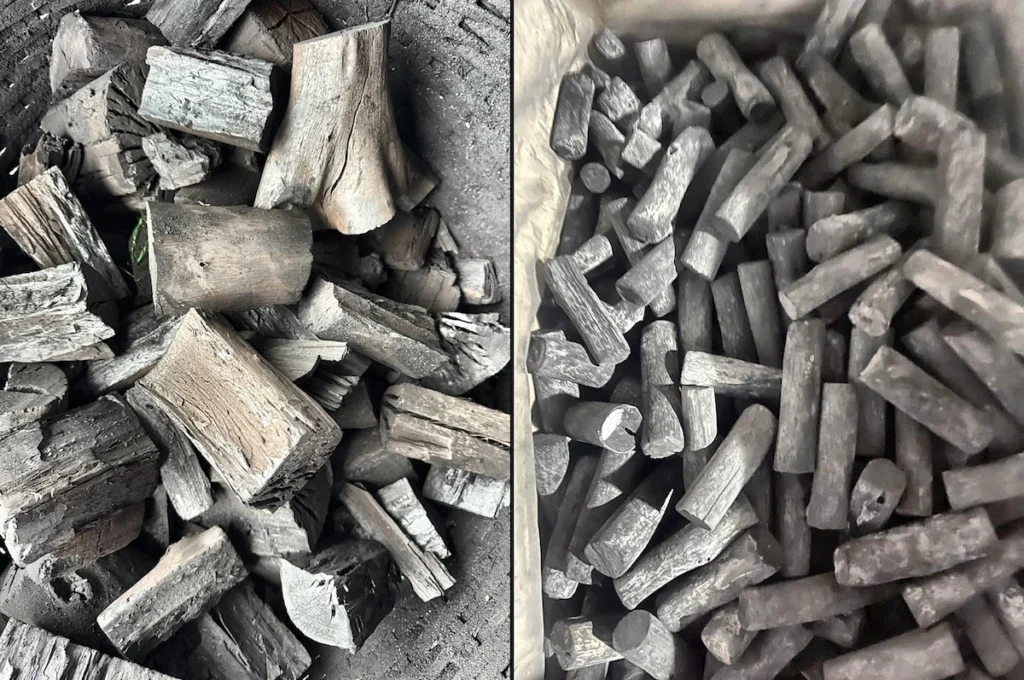
Black Charcoal Vietnam is usually the better fit for buyers seeking versatile commercial fuel, multiple wood options, and scalable supply for BBQ or industrial use. White Charcoal (Binchotan) is better for premium grilling that calls for intense, steady heat and minimal smoke. The right choice depends on your application, required specifications, and landed cost—not color alone, and this guide to Vietnam Firewoods explains how hardwood and softwood choices can affect fuel use. For importers, compare the exact wood, production method, test documentation, and shipment terms, and verify a Vietnamese Binchotan manufacturer before choosing.
Design and Build: How Are the Charcoals Made?
Black Charcoal Vietnam covers several hardwood charcoal products made in Vietnam, while traditional Binchotan is a specific type of white charcoal produced through high-temperature refining and rapid cooling. Their different manufacturing approaches influence appearance, hardness, heat behavior, and the specifications buyers should verify.
What production methods shape each product?
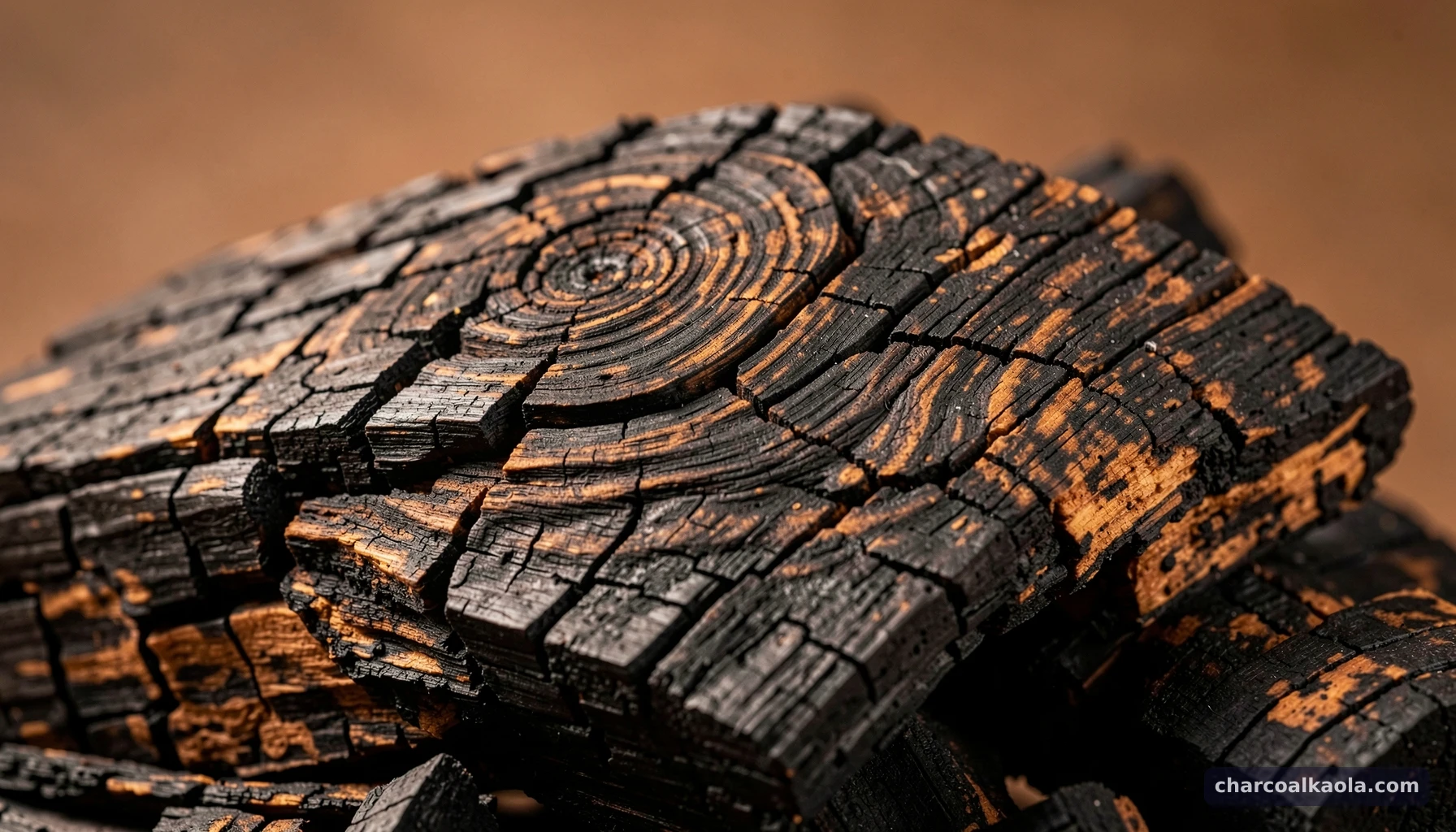
Black charcoal is produced by carbonizing wood in a kiln. Charcoalkaola reports operating 40 traditional kilns at its Quang Tri Province facility, with an approximate output of 180 tons per month. Its black charcoal range includes mangrove, Khaya, longan, coffee, and eucalyptus; the company also produces other charcoal categories, including Binchotan varieties and briquettes.
White charcoal, traditionally known as shiro-zumi, is made by firing charcoal at high temperatures—approximately 1,000°C to 1,200°C—and rapidly cooling it with a mixture of earth, sand, and ash. This treatment gives the charcoal its pale surface and contributes to its characteristic hardness. Traditional Japanese Binchotan is associated with Ubame oak, but products sold as Binchotan can vary by wood species and origin. Buyers should confirm the precise product rather than assume all white charcoal is made from the same wood.
For Black Charcoal Vietnam, Charcoalkaola reports refining temperatures of up to 1,200°C for its products. That figure should not be treated as a universal specification for every black-charcoal grade: confirm the process and test data for the specific item being quoted.
Head-to-head comparison matrix
| Comparison criterion in English | Black Charcoal Vietnam | White Charcoal (Binchotan) | Verdict in English |
|---|---|---|---|
| Product identity | A category that includes hardwood types such as mangrove, Khaya, longan, coffee, and eucalyptus | A high-grade white-charcoal category; traditional Binchotan is associated with Ubame oak | Compare exact wood and grade, not just the color or label |
| Production | Kiln-produced charcoal; supplier reports refining temperatures up to 1,200°C for its products | Fired at high temperatures and rapidly cooled with earth, sand, and ash | Production details matter more than a broad category name |
| Appearance and build | Typically black; characteristics vary by wood and product grade | Pale exterior, dense and hard when genuine and properly produced | White charcoal is distinctive in build; request samples for confirmation |
| Heat and grilling | Product-dependent; some Vietnamese hardwood charcoal is suited to commercial BBQ and heating | Known for intense grilling heat and low-smoke use | Binchotan fits premium grilling; select black charcoal to match the required heat and operating cost |
| Reported calorific value | Charcoalkaola reports up to 7,560 Kcal; confirm the test basis and grade | No comparable calorific figure is provided here | Request like-for-like laboratory data before ranking energy output |
| Smoke and odor | Varies with wood, carbonization, handling, and how the charcoal is burned | Associated with minimal smoke during grilling | Ask for application-specific testing; avoid assuming every batch performs identically |
| Product range | Multiple hardwood species, plus separate briquette and other charcoal categories | A more specialized product category, with wood species depending on source | Black charcoal offers more options across fuel needs |
| Water and household use | Not established as a household water-filter product in the supplied specifications | Porous Binchotan is used for adsorption and deodorizing applications | For household use, choose a product explicitly specified for that purpose |
| Pricing | Quote-dependent; determined by product, order size, packaging, and shipping terms | Quote-dependent; specialized product and specification affect the offer | Compare full landed costs, not assumed market averages |
| Buyer experience | Suits buyers who need several charcoal options or repeat commercial supply | Suits buyers prioritizing a particular grilling experience or specialty use | Match the product to the operation and end customer |
| Ideal audience | Importers, BBQ businesses, wholesalers, and industrial or commercial users | Premium grillers, culinary buyers, and specialty retailers | The best product is the one aligned to your market and verified requirements |
Key Features: What Does Each Type Offer?
Black Charcoal Vietnam’s core advantage is product variety: buyers can specify different hardwoods for distinct commercial requirements. Binchotan’s appeal is its particular combination of density, high-temperature production, and specialty uses, but its characteristics depend on authenticity, wood source, and intended application.
Black Charcoal Vietnam: strengths and limitations
A broad product range can help importers serve multiple customer segments. For example, a BBQ wholesaler may compare eucalyptus or longan charcoal, while an industrial buyer may evaluate a different hardwood based on supply, burn behavior, and cost. Charcoalkaola also offers OEM and private-label options, with customizable sizing and packaging.
Pros
- Multiple hardwood options: Mangrove, Khaya, longan, coffee, and eucalyptus are among the reported black-charcoal products.
- Commercial-scale supply: The Quang Tri facility is reported to have 40 traditional kilns and approximate monthly output of 180 tons.
- Export documentation: Charcoalkaola reports providing MSDS, phytosanitary certificates, and AANZFTA certification, subject to the shipment and applicable requirements.
- Testing support: Products are tested using TCVN, ISO, and ASTM methods, according to the company’s specifications.
- Brand flexibility: OEM and private-label services can help importers align packaging with their own retail or wholesale channels.
Cons
- The category is not one uniform product: Wood species, sizing, and production details can change performance. Buyers need a defined specification, not simply “black charcoal.”
- No universal price or performance ranking: The available figures do not establish one price for all grades or prove that every product is suitable for every grill or industrial process.
- Documentation must be matched to destination: Export paperwork and testing do not automatically guarantee compliance with every importing market’s rules. Buyers should confirm requirements with their customs broker or relevant authority.
White Charcoal (Binchotan): strengths and limitations
Genuine Binchotan is valued for its dense structure and use in high-heat cooking. Its fine pores also support certain household applications, such as adsorption and odor management, but those uses should not be confused with a guarantee of drinking-water safety.
Pros
- Distinctive grilling characteristics: Binchotan is associated with intense infrared heat and minimal smoke, making it attractive for premium grilling and yakitori-style cooking.
- Dense, hard build: Genuine Binchotan is described as hard and metallic-sounding when tapped; density and a tendency to sink in water can help assess authenticity.
- Specialty household uses: Porous charcoal may be used for adsorption, deodorizing, or humidity management.
- Potential reuse for water infusion: The provided guidance describes reuse for around one to three months, depending on frequency and care.
Cons
- Authenticity and origin need checking: Traditional Binchotan is associated with Ubame oak, but products described with the Binchotan name may use other woods. Ask for the species, origin, and production details.
- Specialized handling: White charcoal is hard and can be challenging to ignite compared with some other charcoal types. The buyer should trial it with the intended equipment and operating procedure.
- No verified price comparison is available: Do not assume a fixed premium or savings. Request a quote for the required grade and compare it with a suitable black-charcoal alternative.
- Water use requires care: For any charcoal intended for drinking-water use, follow the supplier’s preparation guidance and do not use soap or detergents. Charcoal is not a substitute for a certified treatment system when one is required.
Performance Benchmarks: Which Performs Better?
There is no defensible universal winner on heat output or operating cost without matched test results for the exact grades. Black charcoal has a reported calorific value of up to 7,560 Kcal for Charcoalkaola products, while Binchotan is known for high-heat grilling; buyers should compare the same test basis, application, and shipment specification.
Heat, fuel use, and cooking conditions
For commercial BBQ, a useful comparison is not simply “which burns hotter?” Consider whether the charcoal produces the heat pattern your cooking process needs, how consistently the pieces fit your equipment, and how much fuel is consumed per service period. Test a representative sample under the same grill setup before switching an established operation.
Charcoalkaola reports refining temperatures of up to 1,200°C and calorific values of up to 7,560 Kcal. These are supplier-reported maximum figures, not a guarantee for every wood species, lot, or order. Ask for the report tied to the product grade and clarify the measurement units and test conditions before using the figure in a procurement model.
Binchotan is associated with high-intensity infrared heat and minimal smoke, which can suit premium grilling where cooking characteristics are central to the menu. That does not automatically make it the most economical option: actual value depends on the amount used, replacement frequency, and the price delivered to your location.
What should buyers test before placing a bulk order?
Use a sample evaluation that reflects how the product will actually be used. Record the product’s wood species, dimensions, packaging, and batch identification so results can be compared fairly.
A practical test plan:
- Define the application. Specify restaurant grilling, wholesale resale, industrial heating, or another use.
- Set measurable requirements. Agree on dimensions, moisture or ash requirements if relevant to your process, and any required laboratory test methods.
- Request product-specific documentation. Ask for available test reports and an MSDS; verify that the documents correspond to the quoted grade.
- Run a controlled trial. Use the same equipment, operating conditions, and cooking or heating process for both samples.
- Record operating results. Track ignition procedure, usable heat period, smoke, handling, breakage, and fuel consumed for the task.
- Confirm import conditions. Review phytosanitary and other destination-specific requirements with your broker before confirming shipment.
This process is more useful than applying a generic industry percentage or relying on a single headline calorific value. In 2026 procurement planning, request current quotes and current documentation because availability, freight, and import conditions can change.
Real-World Usability: Which Buyers Should Choose Each?
Black charcoal is often the more flexible choice for wholesalers and operators who need a range of hardwood products or scalable commercial supply. Binchotan is the more specialized choice for premium cooking and select household applications, provided the product’s origin and suitability are verified.
When is Black Charcoal Vietnam the better fit?
Choose Black Charcoal Vietnam when your priority is sourcing a specified hardwood product for commercial BBQ, wholesale distribution, or industrial use. It may also suit importers building a private-label range, especially when they need custom sizing or packaging and want to discuss multiple product categories with one supplier.
Charcoalkaola’s reported export markets include Japan, South Korea, the United States, the EU, the Middle East, and Australia. Market presence is useful context, but it is not a substitute for checking the rules for your own destination, product classification, or intended use.
For a specific hardwood requirement, buyers can review Charcoalkaola’s eucalyptus black charcoal product information. Those considering a commercial BBQ fuel can also compare the supplier’s Vietnam mangrove charcoal information for industrial BBQ use.
Choose Black Charcoal Vietnam if you:
- Need hardwood options such as eucalyptus, longan, coffee, mangrove, or Khaya.
- Buy for a restaurant group, wholesaler, or commercial heating application.
- Need OEM or private-label packaging.
- Want to compare several charcoal types through a supplier with export experience.
- Can define and verify the grade, testing, documentation, and shipment terms you require.
When is White Charcoal (Binchotan) the better fit?
Choose Binchotan when your end customer values premium grilling characteristics and your operation can accommodate its sourcing and handling requirements. It can be a strong fit for restaurants and specialty retailers focused on high-heat cooking, where the product experience matters as much as the fuel cost.
For water infusion, deodorizing, or humidity management, use only charcoal sold and documented for the intended household purpose. The available facts describe traditional Binchotan’s porous properties and household uses, but they do not establish a universal certification or make every white-charcoal product safe for drinking-water treatment.
Choose White Charcoal (Binchotan) if you:
- Operate a premium grill or yakitori-style menu where intense heat and minimal smoke are desirable.
- Need a specialty product rather than a broad commercial-fuel range.
- Can verify wood species, origin, production method, and intended-use guidance.
- Have tested the product in your equipment and confirmed the landed cost works for your business.
- Are buying for household use and can follow the supplier’s preparation and maintenance directions.
Value for Money: How Should You Compare Costs?
The better value is the charcoal that meets your performance and compliance requirements at the lowest workable total cost—not necessarily the lowest quoted unit price. Neither product has one fixed price: grade, wood, order volume, packaging, shipping, and agreed Incoterms all affect the final comparison.
Build a fair, delivered-cost comparison
Ask both suppliers to quote comparable specifications and shipment terms. A quote for one wood species, piece size, or packaging format cannot be fairly compared with a different product simply because both are charcoal.
Include these items in your cost review:
- Product specification: Wood species, grade, piece dimensions, and any agreed quality limits.
- Order volume and packaging: Carton or bag format, pallet configuration, and private-label requirements.
- Testing and documents: Which reports and certificates are included, and whether destination-specific documents are available.
- Shipping terms: Confirm the Incoterm, port, freight responsibilities, and any other charges your importer must pay.
- Usable performance: Compare fuel consumed for the same cooking or heating task, rather than price per kilogram alone.
- Operational handling: Consider storage, ignition procedure, breakage, and staff familiarity.
A product with a higher unit quote may still work better if it meets a specific premium-use requirement; a lower-priced product may be the more practical choice for large-volume operations. Those outcomes must be established through your quote and sample trial, not assumed from the product category.
A buyer decision framework and next steps
Use this short framework to narrow your choice:
- Choose Black Charcoal Vietnam for a flexible commercial supply program, multiple hardwood options, or a private-label project.
- Choose White Charcoal (Binchotan) for specialty grilling where its high-heat characteristics and low-smoke profile are central to the offer.
- Request samples of both if your operation is new to either product or if performance is critical to your menu or process.
- Ask for product-specific evidence before making claims about calorific value, origin, compliance, or intended household use.
- Compare landed cost and trial results before committing to a recurring order.
Charcoalkaola has more than 10 years of charcoal export experience and provides technical and logistics support for international buyers. To assess fit, contact the company through charcoalkaola.com with your target product, volume, destination, packaging, and required documents. Ask for a quotation, sample options, and the specification sheet for the exact grade under consideration.
FAQ
These answers summarize the main buying differences: black charcoal offers broader hardwood and commercial-supply options, while Binchotan serves more specialized grilling and household applications. Always confirm the quoted product’s specifications, documentation, and destination requirements.
Is Black Charcoal Vietnam better than White Charcoal (Binchotan)?
Neither is universally better. Black Charcoal Vietnam can suit commercial buyers who want hardwood options and scalable supply; Binchotan can suit premium grilling that prioritizes intense heat and minimal smoke. Choose based on the application, sample performance, and delivered cost.
Which type is better for restaurant grilling?
It depends on the restaurant’s cooking method and cost model. Binchotan is associated with high-intensity infrared heat and minimal smoke, while a suitable Vietnamese hardwood charcoal may fit broader commercial BBQ needs. Test both in the same equipment and compare fuel use for the same service task.
Does Binchotan always come from Ubame oak?
Traditional Japanese Binchotan is associated with Ubame oak, but products sold as Binchotan may use different woods or come from different origins. Confirm the exact species, source, and production method with the supplier before buying.
How should importers compare prices?
Request quotes based on the same wood or grade, order volume, packaging, destination, and shipping terms. Then compare total landed cost and sample-trial performance. There is no reliable universal price comparison without those details.
What should I request before placing a bulk charcoal order?
Ask for the exact product specification, available test reports, MSDS, applicable export documents, packaging details, sample options, and a quote with clearly stated shipping terms. Verify destination-market requirements with your customs broker or relevant authority.
