
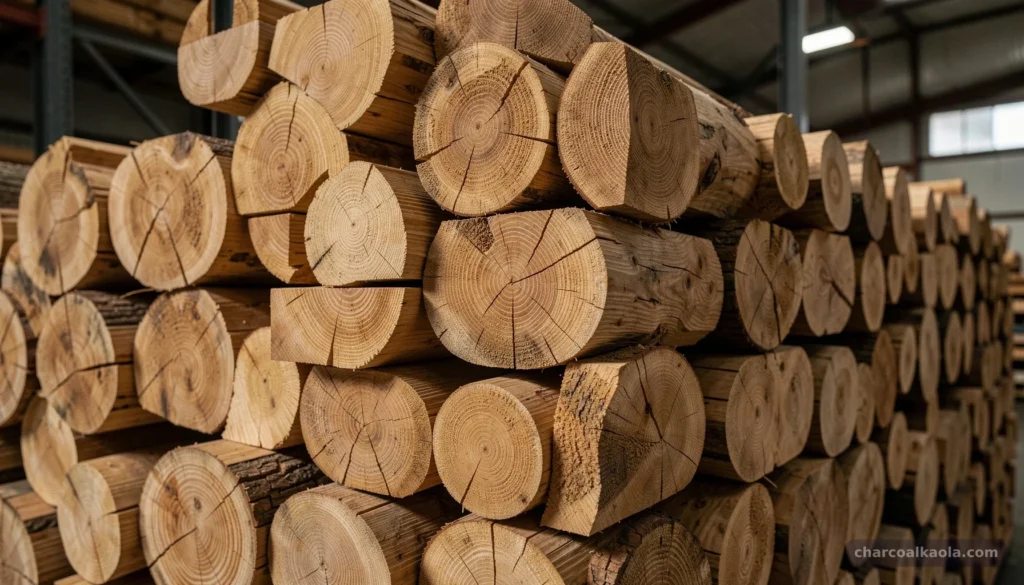
Vietnam Firewoods are kiln-dried, cut-to-size fuel products designed for consistent moisture control, handling, and export use. Their advantage is not that every Vietnamese species automatically outperforms every softwood, but that controlled drying, traceable production, and batch testing can produce dependable heat with less variability. For professional buyers, the meaningful comparison is species density plus moisture, calorific output, ash behavior, and documented quality control.
What Vietnam Firewoods Are and Why Species Matter
Vietnam Firewoods for commercial and home use are processed hardwood fuel products supplied for residential heating, restaurants, commercial kitchens, and industrial biomass applications. At Charcoalkaola, the relevant distinction is between the biological characteristics of timber and the production controls that determine how reliably that timber performs after cutting and drying.
Hardwood versus softwood: the practical distinction
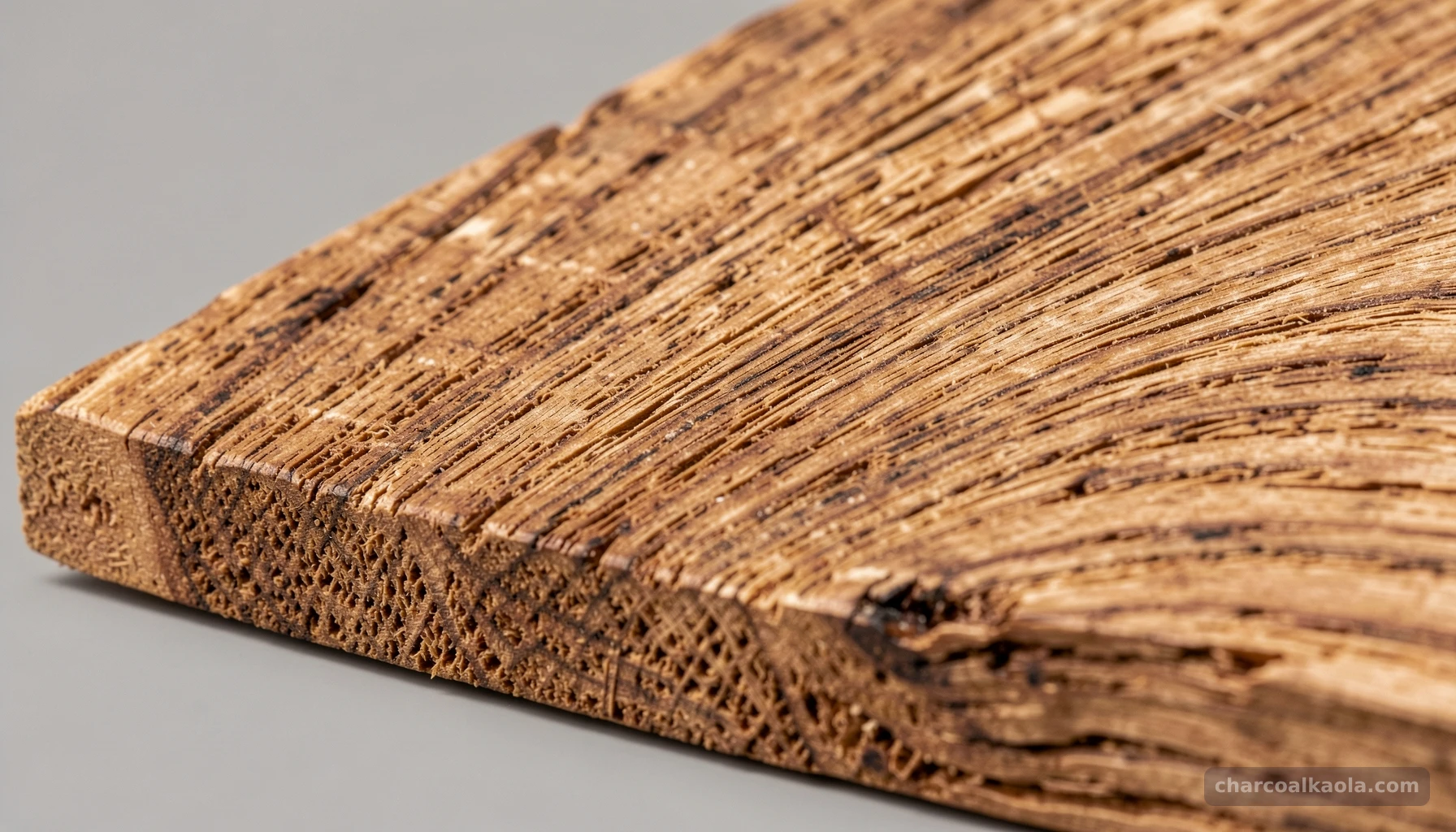
Hardwood generally comes from broadleaf trees, while softwood generally comes from coniferous trees. The terms describe botanical groups, not a universal ranking of fuel quality. Some softwoods can burn efficiently when properly seasoned, and some hardwoods perform poorly when their moisture content is high.
For firewood buyers, density is usually more important than the label alone. Dense hardwood contains more combustible material per unit of volume, which can support longer-lasting heat and fewer reloads. Softwood often ignites rapidly because its lower density and resin content can promote faster flame development, but this may also result in quicker consumption.
Vietnamese hardwood firewood is therefore attractive where the user prioritizes stable heat, predictable loading, and efficient storage. However, a responsible specification must avoid assigning a single calorific value to all timber species. Calorific output changes with moisture, density, bark content, piece size, and laboratory method.
How kiln drying changes fuel performance
Freshly cut wood contains substantial water. During combustion, part of the available energy is consumed evaporating that moisture before the timber can burn efficiently. This commonly causes slower ignition, visible steam or smoke, lower useful heat, and greater operational inconsistency.
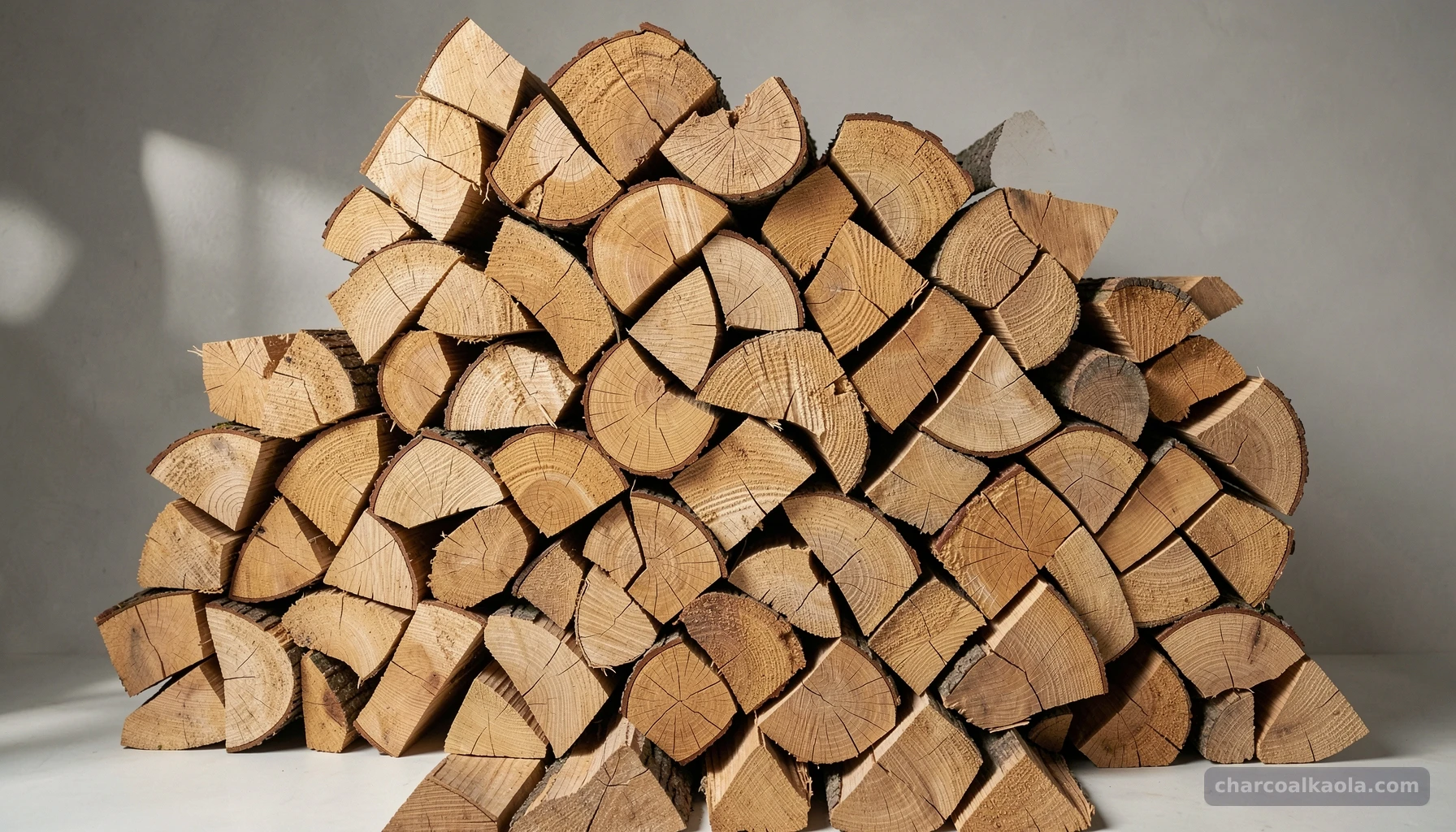
Kiln-dried firewood addresses this issue through controlled drying and cut-to-size processing. KAOLA CO., LTD applies a 100% quality-control process intended to ensure that moisture content meets export requirements. The exact moisture result should still be verified from the batch documentation supplied for a shipment rather than assumed from the phrase “kiln-dried.”
Controlled drying also improves logistics. Uniform pieces are easier to stack, load, inspect, and measure. For commercial users, this matters because fuel performance is linked not only to the timber species but also to the consistency of every delivery.
The real meaning of “superior” in Vietnamese firewood
Vietnam Firewoods can be considered superior when they deliver measurable operational benefits rather than merely carrying a geographic label. These benefits may include:
- Consistent piece dimensions for predictable loading.
- Controlled moisture for more reliable ignition and combustion.
- Lower variability between batches when production and inspection are disciplined.
- Export documentation that supports customs and receiving procedures.
- Traceable testing when buyers require laboratory evidence.
Charcoalkaola’s experience in Vietnam’s charcoal and biomass sector shows why traditional material knowledge must be combined with international procurement controls. The same principle applies to firewood: species selection establishes the potential, while drying, grading, packaging, and testing determine the delivered result.
Technical Specifications: Heat, Duration, and Ash
The performance of Vietnamese timber should be evaluated through a batch-based technical profile. Published species claims are useful for preliminary screening, but procurement decisions should rely on measured moisture, calorific testing, ash results, and the intended combustion system.
Verified product benchmarks and firewood data limits
The table below separates documented product specifications from values that must be measured for a particular firewood batch. This distinction is essential because the available specifications for Charcoalkaola’s charcoal range cannot automatically be transferred to kiln-dried firewood.
| Product or material | Verified technical reference | Burn and residue interpretation |
|---|---|---|
| Kiln-dried cut-to-size firewood | Moisture controlled through a 100% quality-control process; exact result should be confirmed by batch report | Duration depends on species density, moisture, piece size, airflow, and appliance design; ash must be measured or specified per batch |
| Black hardwood charcoal | 6,500–7,500 Kcal; 100% natural lump | Charcoal is not equivalent to firewood; its ash output and burn profile depend on species and carbonization conditions |
| Eucalyptus Binchotan | 85–95% fixed carbon; 2–3% ash for the Binchotan range | High fixed carbon and low ash support sustained, clean high-heat grilling; this is a charcoal benchmark, not a firewood claim |
| Maitiew Binchotan | 85–95% fixed carbon; 2–3% ash for the Binchotan range | Suitable for high-heat cooking applications when the supplied batch conforms to the stated specification |
| Lychee/Longan Binchotan | 85–95% fixed carbon; 2–3% ash for the Binchotan range | Dense charcoal behavior should be assessed through the batch report and intended grill configuration |
| Coffee Binchotan | 85–95% fixed carbon; 2–3% ash for the Binchotan range | Useful as a specialty charcoal reference; it should not be used to predict untreated firewood performance |
| Sawdust briquette | Approximately 89% fixed carbon; 7,000–7,500 Kcal | Designed for consistent, long-duration heat in Shisha and BBQ applications |
| Coconut shell charcoal | Sustainable product; 4–6 hour steady burn time | Odorless, controlled-burning charcoal; duration is a stated charcoal benchmark rather than a firewood duration |
| Refining process | Up to 1,200°C for applicable charcoal production | Refining temperature affects carbonization quality and cannot be converted directly into firewood heat output |
| Testing framework | TCVN, ISO, and ASTM methods are used for applicable product testing | The buyer should identify the exact method, sample basis, moisture basis, and batch covered by each report |
Calorific value: what the number actually tells you
Calorific value indicates the energy released when fuel is combusted under a defined test condition. A figure such as 6,500–7,500 Kcal is documented for Charcoalkaola’s black hardwood charcoal, while sawdust briquettes are approximately 7,000–7,500 Kcal. These figures should not be presented as universal calorific values for Vietnamese firewood.
For firewood, a useful technical request should specify:
- Whether the result is higher heating value or lower heating value.
- Whether the sample is reported on an as-received or dry basis.
- The measured moisture content.
- The test method and laboratory identification.
- The timber species or mixed-species composition.
A dry, dense hardwood may provide more useful heat per piece than a damp, less dense material, even where the nominal laboratory values appear similar. For this reason, professional buyers should compare energy per delivered pallet, cubic meter, or kilogram—not only energy per kilogram under laboratory conditions.
Burn duration and ash residue
Burn duration cannot be responsibly stated as one fixed number for all Vietnamese timber species. It is influenced by moisture, density, cross-sectional size, airflow, chimney draft, loading pattern, and whether the fuel is burned in an open fire, boiler, stove, pizza oven, or grill.
Hardwood commonly supports a longer ember phase than lower-density softwood when both are properly dried and similarly sized. Yet an oversized piece in a low-airflow system may burn slowly but inefficiently, while smaller pieces can release heat quickly regardless of species.
Ash residue is equally dependent on more than timber identity. Bark, soil contamination, mineral content, and combustion completeness all affect ash. Charcoals in the Charcoalkaola range have documented low ash for Binchotan at approximately 2–3%, but that figure must not be applied to raw or kiln-dried firewood. Buyers requiring ash limits should request a specific laboratory result or contractual specification.
A Practical Procurement and Implementation Workflow
A reliable Vietnam Firewoods program begins with a written technical brief and ends with batch verification after arrival. The objective is to align species, dimensions, moisture, documentation, and combustion requirements before shipment.
Step 1: Define the combustion application
Start by identifying how the wood will be used. Residential heating, restaurant cooking, industrial boilers, outdoor fire pits, and biomass distribution each require different specifications.
Record the following:
- Appliance or furnace type.
- Required piece length and diameter.
- Expected daily or monthly consumption.
- Loading method and storage conditions.
- Acceptable moisture range.
- Maximum ash tolerance.
- Required packaging and pallet format.
- Destination port and import documentation.
A restaurant using wood for open-fire cooking may prioritize aroma, stable ember formation, and dimensional consistency. An industrial user may instead prioritize energy density, automated feeding compatibility, and ash management. Without this application profile, a supplier cannot determine whether hardwood, mixed timber, briquettes, or charcoal is the most suitable fuel.
Step 2: Request a batch-specific technical package
The next stage is verification rather than assumption. Charcoalkaola’s export workflow allows a buyer to request transparent laboratory data and product documentation before shipment.
A professional request should include:
- Product name and timber description.
- Quantity and required delivery schedule.
- Target dimensions and packaging.
- Moisture documentation for the specific batch.
- Calorific test data where available.
- Ash or residue results if operationally important.
- MSDS requirements.
- Phytosanitary and customs documentation.
- OEM or private-label packaging requirements.
The supplier can support shipments with MSDS, laboratory reports, and phytosanitary documentation. For applicable product categories, testing may reference TCVN, ISO, or ASTM methods. The buyer should check that the report corresponds to the exact product, not merely a generic company catalogue specification.
Step 3: Approve a sample and define acceptance criteria
Before committing to routine supply, inspect a representative sample. A useful sample review includes visual grading, dimensions, moisture measurement, packaging integrity, odor, bark ratio, foreign material, and combustion behavior in the intended equipment.
Acceptance criteria should be written in measurable terms. For example:
- Piece dimensions within an agreed tolerance.
- No visible mold, soil, or chemical contamination.
- Moisture documented using an agreed test basis.
- Species or mixed-species description confirmed.
- Maximum bark percentage stated where relevant.
- Ash or calorific requirements linked to a defined test method.
A burn trial is informative but should not replace laboratory analysis. Small-scale combustion can reveal ignition behavior, smoke, spark formation, ember stability, and residue accumulation. It cannot by itself establish a defensible calorific value.
Step 4: Coordinate export and arrival inspection
KAOLA CO., LTD operates from Quang Tri Province with 40 traditional kilns and a stated monthly output of 180 tons across its production activities. Export coordination includes shipment planning to major global ports and support for phytosanitary documentation and AANZFTA certification where applicable.
On arrival, the importer should inspect:
- Container or truck condition.
- Pallet count and package labels.
- Signs of moisture ingress.
- Weight against shipping documents.
- Random moisture readings.
- Piece-size consistency.
- Visible contamination or deterioration.
Any discrepancy should be recorded immediately with photographs, lot numbers, and inspection data. This creates a traceable feedback loop between the supplier, logistics provider, and receiving operation.
Pro Tips, Common Pitfalls, and Application Examples
The best firewood programs control the variables that operators can actually measure. Species is important, but it is only one part of the performance equation.
Common mistakes in hardwood and softwood comparisons
Mistake one: treating density as a complete quality guarantee. Dense wood can still perform poorly if it is wet, oversized, contaminated, or unsuitable for the combustion chamber. Always evaluate density alongside moisture and dimensions.
Mistake two: copying charcoal specifications onto firewood. Fixed carbon, ash, and calorific figures for Binchotan or briquettes describe carbonized products. They cannot be used as direct specifications for kiln-dried timber.
Mistake three: comparing laboratory heat with delivered heat. A dry-basis calorific result does not describe the energy received when fuel absorbs moisture during storage. Warehouse protection and packaging are therefore part of fuel quality.
Mistake four: assuming burn duration is independent of equipment. A restaurant grill, domestic stove, and industrial boiler extract heat differently. Airflow and loading procedures can change consumption substantially.
For a broader comparison of carbonized fuel categories, buyers may also consult Charcoalkaola’s guide to Black Charcoal Vietnam versus White Charcoal.
Case example: commercial heating and restaurant supply
Consider a restaurant group operating multiple wood-fired cooking stations. The group may prefer dense, kiln-dried hardwood because consistent piece dimensions simplify staff training and reduce variation between cooking shifts. Its procurement team should still validate smoke behavior, ember stability, ash handling, and moisture at each receiving location.
A commercial heating distributor may require a different solution. It may value predictable pallet volume, low storage losses, documented moisture, and compatibility with existing combustion equipment. In that case, the best product is not necessarily the hardest timber; it is the fuel that delivers reliable energy at the lowest operational variability.
Charcoalkaola’s product range also includes pressing charcoal, sawdust briquettes, and coconut shell charcoal. These alternatives may be more appropriate where uniform geometry, extended heat, or low-odor combustion is more important than the characteristics of split firewood.
Practical optimization tips for buyers
To improve results in 2026 procurement programs:
- Compare suppliers using the same moisture and calorific test basis.
- Separate species claims from batch performance claims.
- Use covered, ventilated storage to prevent re-absorption of moisture.
- Track fuel consumption per operating hour, not only per shipment.
- Record ash volume and cleaning frequency.
- Match piece dimensions to the appliance manufacturer’s guidance.
- Establish a receiving inspection checklist before the first container arrives.
- Review performance after seasonal changes because ambient humidity affects storage.
Buyers seeking species-specific carbonized fuel can also review the technical profile of Eucalyptus Black Charcoal from Vietnam, while remembering that charcoal data and firewood data must remain analytically separate.
Enterprise Considerations and the 2026 Strategic Outlook
For enterprise buyers, Vietnam Firewoods should be managed as a documented supply-chain category rather than an informal commodity purchase. The strategic advantage comes from combining Vietnamese production capacity with measurable specifications, export compliance, and repeatable receiving controls.
Scaling supply without sacrificing consistency
KAOLA CO., LTD reports 10+ years of export experience and production capacity supported by 40 traditional kilns in Quang Tri Province. For international wholesalers, restaurant chains, Shisha suppliers, and industrial fuel distributors, this operating background provides a foundation for long-term planning.
Scaling should nevertheless be based on quality systems, not output alone. A buyer should establish:
- Approved product descriptions.
- Batch and lot identification.
- Document-retention requirements.
- Pre-shipment inspection procedures.
- Packaging and labeling standards.
- Nonconformance and corrective-action procedures.
- Forecasting and shipment windows.
- Approved destination-port documentation.
OEM and private-label requirements should be agreed early, especially where dimensions, carton design, pallet configuration, or regulatory markings differ between Japan, South Korea, the United States, the European Union, and Middle Eastern markets.
Compliance, sustainability, and market direction
In 2026, professional fuel buyers are increasingly expected to demonstrate not only price competitiveness but also traceability, safety, and predictable environmental handling. MSDS availability, phytosanitary support, laboratory reports, and customs-ready documentation can reduce friction during import and receiving.
Sustainability claims should remain precise. Coconut shell charcoal is described as a sustainable, odorless fuel with a 4–6 hour burn time, but those characteristics apply to that charcoal product—not automatically to Vietnamese firewood. Similarly, a claim of “natural hardwood” does not substitute for responsible sourcing documentation or batch testing.
The strategic direction is clear: suppliers that can connect traditional kiln craftsmanship with TCVN, ISO, and ASTM-oriented testing will be better positioned for international procurement. Charcoalkaola’s perspective is that product suitability should be demonstrated through technical evidence, not broad claims about origin or species.
How should an enterprise choose between hardwood, softwood, and charcoal?
The decision should follow the operating objective. Choose kiln-dried hardwood where the application requires split or cut-to-size timber, stable loading, and a sustained ember profile. Consider softwood where rapid ignition is useful and consumption speed is acceptable, provided it meets the equipment and moisture requirements.
Choose charcoal when high-temperature grilling, low moisture, controlled odor, or extended ember performance is the priority. Binchotan offers 85–95% fixed carbon and approximately 2–3% ash within the stated product range, while sawdust briquettes provide approximately 89% fixed carbon and 7,000–7,500 Kcal.
The correct comparison is therefore not “hardwood always wins.” It is which verified fuel delivers the required heat, duration, ash behavior, and handling performance in the intended system?
FAQ
Are Vietnam Firewoods always hardwood?
No. Vietnam Firewoods should be specified by the actual timber composition, not by country of origin alone. Charcoalkaola’s documented firewood product is cut-to-size, kiln-dried firewood with a 100% quality-control process for export-standard moisture management, but a universal species claim should not be assumed. Buyers should request the timber description, dimensions, moisture data, and any available laboratory information before approving a shipment.
What is the calorific value of Vietnamese firewood?
There is no single defensible calorific value for all Vietnamese firewood. Results depend on species, moisture, density, bark content, sample basis, and laboratory method. Charcoalkaola documents 6,500–7,500 Kcal for black hardwood charcoal and approximately 7,000–7,500 Kcal for sawdust briquettes, but those figures must not be transferred to kiln-dried firewood. Request batch-specific testing when energy calculations are critical.
Does hardwood firewood burn longer than softwood?
Hardwood often supports a longer ember phase because its higher density can place more combustible material into each piece. However, burn duration also depends on moisture, dimensions, airflow, loading pattern, and appliance design. Properly dried softwood may ignite faster and perform effectively in applications requiring rapid heat. The most reliable comparison is a controlled trial using equal loads and the same equipment, supported by moisture and consumption records.
What documents should an international firewood buyer request?
An international buyer should request a product specification, batch moisture information, packaging details, laboratory reports where applicable, MSDS documentation, and phytosanitary support. The buyer should also confirm export labeling, dimensions, quantity, destination requirements, and the relevant testing method. KAOLA CO., LTD supports international shipments with MSDS, test reports, customs documentation, and phytosanitary assistance, with logistics coordinated from Vietnam to major global ports.
