A reliable Vietnamese Binchotan manufacturer should be able to explain its traditional kiln techniques, document product specifications, and support export compliance before you place a bulk order. For B2B buyers, verification means checking the actual production facility, matching lab reports to the product and shipment, and confirming packaging and destination-market requirements. This guide sets out practical checks using Charcoalkaola’s manufacturing and export experience.
What a Vietnamese Binchotan Manufacturer Actually Does
A Vietnamese Binchotan manufacturer converts selected hardwood into dense white charcoal through high-temperature kiln firing, then prepares it to meet buyer requirements for size, packaging, and export. To assess a supplier, look beyond product claims: verify its production capacity, process controls, product range, and ability to provide shipment documentation.
Understand the factory, kiln process, and product range
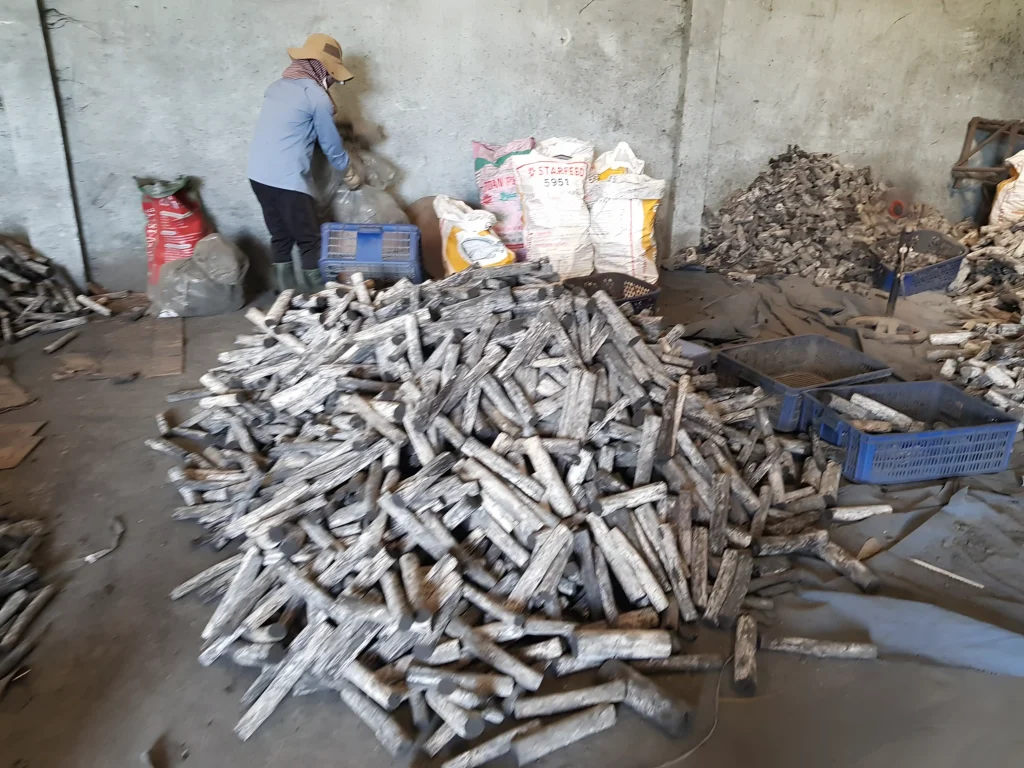
Binchotan is not simply any hardwood charcoal, so buyers comparing it with Black Charcoal Vietnam should consider each product’s characteristics and intended use. Its high density and long-burning performance depend on the wood selected and the carbonization process. At KAOLA CO., LTD, production is based in Quang Tri Province, Vietnam, with 40 traditional kilns and a stated capacity of 180 tons per month. Kiln firing reaches temperatures of up to 1,200°C.
These figures provide useful audit questions, not a substitute for inspection. Ask how the supplier tracks production batches, how it controls kiln firing, and whether it can show how a particular order moves from raw material through finished goods. Confirm that capacity figures refer to the relevant facility and product range, and clarify whether your requested volume can be produced within your schedule.
The portfolio includes Eucalyptus, Maitiew, Lychee/Longan, and Coffee Binchotan, alongside black charcoal, sawdust briquettes, coconut shell charcoal, and cut-to-size firewood. Product names alone do not establish equivalence: wood type and intended use matter. If you are comparing a specific hardwood option, review the product details for Eucalyptus Binchotan and request samples or specifications for the exact grade you plan to import.
Check production evidence, not just supplier claims
A factory audit should test whether the supplier’s stated production capability matches its facilities and records. During a visit—or a structured remote audit—ask to see the production areas, kiln operations where accessible, finished-goods storage, packaging process, and records associated with a representative batch. Take notes on what was observed and what remains unverified.
For each product under consideration, request a specification sheet and ask the supplier to identify the relevant test method and reporting laboratory. Charcoalkaola states that its products are tested according to TCVN, ISO, and ASTM methods. Because the fact sheet does not establish that every test is performed under every method for every product, confirm the exact scope of each report rather than relying on a general standards list.
Also ask whether report details match the product type and batch being quoted. A generic document may help with initial screening, but it is not the same as shipment-specific verification. Keep the confirmed specification, sample assessment, and agreed tolerances in the purchase documentation so that both parties have a clear reference point.
Which Quality Specifications and Documents Should Buyers Compare?
A supplier is easier to qualify when its product data and export documents can be checked against your order requirements. Compare each specification by product and evidence type; do not treat a single headline figure or certificate as proof of every quality or import requirement.
Compare the key technical specifications
Use a comparison matrix to record what the supplier claims, what the supporting document states, and what your business needs. The values below reflect the available company specifications; they are not guarantees for every charcoal type or shipment.
| Checkpoint | Charcoalkaola’s stated information | What the buyer should verify |
|---|---|---|
| Production base | Quang Tri Province, Vietnam | Confirm the facility producing the quoted item |
| Production capacity | 180 tons per month across 40 traditional kilns | Confirm available capacity and lead time for your order |
| Kiln temperature | Up to 1,200°C | Ask how the process is monitored and recorded |
| Calorific value | Up to 7,560 Kcal | Check the report, units, product type, and test method |
| Testing references | TCVN, ISO, and ASTM methods | Request the actual reports and clarify their scope |
| Chemical information | Low-sulfur content; MSDS available for all products | Review the product-specific MSDS and any relevant test data |
| Export documents | AANZFTA certification and phytosanitary certificates provided | Confirm document availability and destination-country requirements |
| Custom orders | Sizing, packaging, and OEM/private label options | Approve written specifications and packaging artwork |
The table is a starting checklist, not a pass/fail score. For example, “up to 7,560 Kcal” is a stated maximum, not a promise that every grade or batch reaches that value. Ask for results relevant to the product you are buying, and align the purchase contract with those confirmed specifications.
Match certifications and documents to the destination
Ask the exporter which documents it can provide for your product and shipment. Charcoalkaola states that MSDS documentation is available for all products and phytosanitary certificates are provided for international shipping. It also identifies AANZFTA certification. These documents can support trade and import processes, but requirements depend on the product, route, and destination rules.
Before production, give your customs broker or compliance team the product description, wood or material type, packaging details, and proposed shipping route. Ask them to confirm which certificates, declarations, and tariff documentation are required. AANZFTA may be relevant to eligible trade between participating markets, but do not assume a certificate automatically reduces duties; confirm eligibility, rules of origin, and current requirements with the appropriate trade adviser.
Check document consistency: exporter and consignee names, product descriptions, quantities, and shipment details should match across commercial and compliance paperwork. Agree on who prepares each document, when drafts will be shared, and who checks them before originals are issued. Resolve discrepancies before cargo dispatch, when corrections can become more difficult and costly.
How to Qualify a Supplier Before Placing an Import Order
A practical qualification process moves from a precise inquiry to sample approval, document checks, and written order controls. Buyers should keep a record of decisions at each step so that the approved product, factory, and compliance documents are clear before shipment.
Follow a five-step supplier verification process
Send a detailed inquiry. Contact the manufacturer through its official website, charcoalkaola.com, and state the charcoal type, intended use, target dimensions, volume, destination, and packaging needs. This helps the supplier quote the correct product rather than a loosely comparable grade.
Confirm the product and commercial scope. Clarify whether you need Binchotan, black charcoal, briquettes, or another item. Agree on size tolerances, packaging, OEM or private-label requirements, order quantity, and lead time. Request a written quotation linked to those details.
Review evidence and assess the factory. Request product specifications, relevant lab reports, MSDS, and export-document information. Arrange a factory visit or remote audit if appropriate. Ask how the supplier controls production and identifies batches, and record which claims you have verified directly.
Evaluate a sample against agreed criteria. Check the sample for the dimensions, condition, packaging, and performance characteristics relevant to your business. If laboratory confirmation is important, agree who will arrange testing and which method applies. Do not assume a sample automatically represents every future production batch.
Approve the order and shipment documents. Put the product description, tolerances, packaging, quantity, documentation responsibilities, and inspection arrangements in writing. Review draft export documents before dispatch and have your customs broker confirm the destination requirements.
Turn buyer requirements into written controls
A strong purchase specification is more useful than a vague request for “premium charcoal.” Include the product variety, dimensions or size range, packaging configuration, labeling language, and any testing or document requirements. If you need a particular calorific value or other technical threshold, state the required method and evidence rather than relying on an unqualified maximum claim.
Define how nonconforming goods will be handled before production starts. For example, specify whether an agreed pre-shipment inspection is required, what sample size or inspection scope will apply, and how discrepancies should be reported. These arrangements need to be agreed with the supplier; they should not be assumed to be part of a standard order.
The manufacturer’s export workflow begins with a quote request, moves through product and packaging customization, quality-document review, production, and bulk shipment. Charcoalkaola reports experience with large export orders, including documented shipments of more than 850 cartons. Buyers should still confirm their own order’s carton count, pallet or container plan, shipment schedule, and documentation rather than infer them from another shipment.
How to Avoid Pitfalls and Assess the 2026 Outlook
The most common sourcing risks are mismatched specifications, incomplete document checks, and assumptions that a factory’s general credentials apply automatically to every product or destination. For 2026 procurement, buyers should prioritize traceable evidence, clearly defined requirements, and early coordination with their logistics and compliance teams.
Avoid common verification mistakes
- Treating capacity as guaranteed availability: A stated capacity of 180 tons per month describes the manufacturer’s reported production capability, not necessarily open capacity for your delivery window. Confirm scheduling and order-specific lead time.
- Accepting a generic lab report: Match the report to the product type, test method, and relevant batch or production period. Ask questions if the document does not make those connections clear.
- Assuming certification settles customs requirements: AANZFTA documentation and phytosanitary certificates can be relevant, but the importer remains responsible for confirming current destination rules and eligibility.
- Comparing unlike charcoal products: Eucalyptus Binchotan, coconut shell charcoal, black charcoal, and briquettes are distinct products. Compare like with like, based on intended use and the specification you need.
- Leaving packaging until late: Confirm carton configuration, labels, and private-label artwork before production. Late changes can affect the order schedule and create avoidable documentation inconsistencies.
A practical case example: a restaurant importer seeking Binchotan for high-heat grilling should define the wood variety, target size, packaging, and performance evidence before requesting a quote. A distributor sourcing private-label charcoal should additionally approve artwork, carton details, and destination-language labeling before production. These are buyer-side planning examples, not claims about guaranteed product outcomes.
Apply a 2026 procurement lens
In 2026, international buyers should treat supplier qualification as a continuing control, not a one-time certificate check. Reconfirm specifications when changing product variety, packaging, factory, or destination market. Ask for updated documentation when the order scope changes, and retain the approved quotation, sample assessment, test reports, and shipping documents together.
Charcoalkaola’s perspective, informed by more than 10 years in Vietnam’s charcoal manufacturing and export sector, is that reliable sourcing depends on connecting traditional kiln production with clear procurement evidence. The company serves markets including Japan, South Korea, the United States, the EU, and the Middle East, and positions itself as a direct manufacturer. For buyers, direct access can make technical and order discussions more straightforward, but independent verification remains essential.
Use a simple decision rule: proceed when the product is clearly specified, the evidence is relevant, the factory’s role is understood, and the export-document plan is confirmed with your broker. If one of those elements is unresolved, pause and request clarification before committing to a bulk order.
FAQ
How can I verify that a Vietnamese Binchotan supplier is a real manufacturer?
Ask for the production facility location, arrange a site visit or structured remote audit, and review evidence of the relevant kiln and production operations. Confirm that the company producing the quoted product is the same party responsible for its specifications and order documentation.
What quality documents should I request before importing Binchotan?
Request the product specification, relevant lab test reports, and MSDS. Confirm which standards or methods were used and whether the evidence applies to the product you are buying. Ask which export documents are available, then check destination requirements with your customs broker.
Does a calorific value of up to 7,560 Kcal apply to every product?
No. “Up to 7,560 Kcal” is a stated maximum, not a guaranteed value for every charcoal type or shipment. Request the applicable report and confirm the product, units, test method, and any order-specific requirement.
Can a supplier’s AANZFTA certification reduce my import costs?
It may be relevant to eligible trade, but certification alone does not establish that a particular shipment qualifies for preferential treatment. Confirm current rules of origin, product eligibility, and documentation requirements with a qualified trade adviser or customs broker.
Can I request custom sizes or private-label packaging?
Charcoalkaola offers customization for sizing and packaging, including OEM and private-label options. Confirm dimensions, tolerances, artwork, labeling, and packaging details in writing before production begins.
