
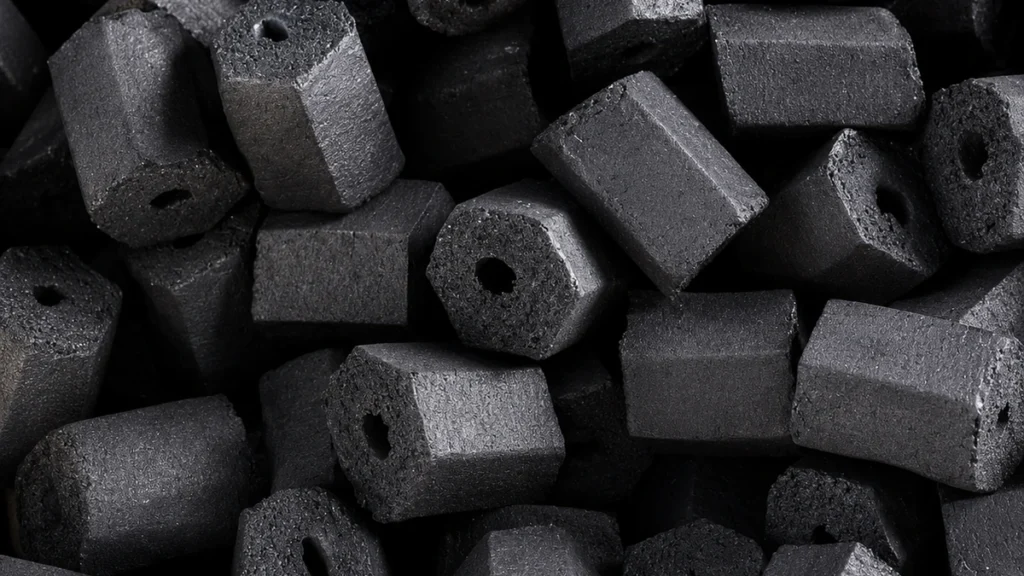
Is coconut shell charcoal better for shisha? Purpose-made coconut-shell briquettes are a relevant option, but the feedstock name alone cannot prove that a product suits your heat-management device (HMD). For a wholesale decision, approve the actual briquette formulation, dimensions and sample performance—not a generic promise of low ash or a four-to-six-hour burn.
This checklist focuses on sample approval for B2B buyers. For the broader fuel-category distinction, read our shisha charcoal versus Binchotan buyer guide. KAOLA does not recommend its Binchotan as a substitute for purpose-made shisha charcoal.
Coconut-shell briquettes are not the same as raw shell charcoal
Raw carbonized coconut-shell pieces and finished shisha briquettes are different purchase items. A finished briquette has a specified shape and formulation, including any binder or other ingredients. A photograph of loose shell charcoal does not establish that a supplier can deliver the cube, flat or shaped briquette your equipment requires.
Kaloud’s equipment guidance discusses natural coconut charcoal and stresses product compatibility. It does not certify KAOLA products or establish compatibility with every HMD. Use the instructions for the actual charcoal and device being evaluated.
Start with the KAOLA coconut-shell charcoal product overview, then ask the CharcoalKaola Team which proposed form, size and packing can be quoted. Availability and acceptance criteria must be confirmed for the order.
Write a shisha-charcoal sample brief before requesting a price
A useful sample request describes the equipment and the purchase decision it must support. Avoid asking only for the supplier’s “best quality”: the parties may interpret that phrase differently.
- Product: purpose-made shisha briquette, feedstock and disclosed formulation.
- Geometry: shape, dimensions, tolerances and acceptable broken-piece level.
- Equipment: intended HMD or other manufacturer-approved setup.
- Evidence: requested laboratory parameters, methods, units and reporting basis.
- Commercial details: sample quantity, wholesale quantity, packing, destination and any private-label needs.
- Approval: what will be checked, who decides and how the approved sample will be identified.
Do not specify a universal cube size or fixed coal count without checking equipment instructions. Matching the device matters more than copying another buyer’s specification.
Sample approval checklist for coconut shisha charcoal
| Check | Record | Approval question |
|---|---|---|
| Identity and formulation | Supplier sample reference, feedstock and declared ingredients. | Is this the product proposed for the order? |
| Shape and dimensions | Measurements from several pieces and any damage. | Does it fit the intended equipment within agreed tolerances? |
| Quality evidence | Applicable moisture, ash, carbon or calorific-value report; method and basis. | Does the evidence cover this product rather than another charcoal? |
| Equipment trial | Setup, sample ID, operating conditions and observations. | Is behavior repeatable under the intended manufacturer-approved conditions? |
| Packing | Net weight, piece condition, liner and proposed label. | Does it meet the agreed handling and distribution needs? |
| Decision | Approved, conditional or not approved; outstanding actions. | What must be resolved before a bulk order? |
Compare performance without inventing a burn-time promise
Useful heat duration depends on briquette dimensions, formulation, airflow, equipment and the endpoint used in the assessment. “Still glowing” is not necessarily the same as delivering useful heat. Ask how a supplier measured its claim and record the same endpoint when comparing samples.
This guide does not assign a four-to-six-hour burn time to KAOLA coconut charcoal. Nor does it transfer a calorific-value result from Eucalyptus Binchotan to a coconut briquette. Any numerical result must identify the tested material, units, method and reporting basis.
Moisture deserves a separate check, but it does not explain every performance difference. See our shisha charcoal moisture and storage guide for that narrower issue. Investigate formulation, damage, device fit and operating conditions rather than assuming one cause.
Low ash and neutral odor are not safety certifications
Do not describe coconut charcoal as harmless, carbon-monoxide-free or safe because it produces little visible smoke. The CDC explains that hookah charcoal can produce carbon monoxide and other harmful substances. Smoking carries serious health risks. Never burn charcoal indoors; follow product warnings and applicable rules. An HMD or an electric charcoal lighter does not eliminate the hazards of burning charcoal.
An unusual odor is a reason to stop the assessment and investigate, not evidence of sulfur content by smell alone. Product composition and laboratory findings must be evaluated separately. Do not ask staff to continue exposure to resolve a procurement question.
Connect sample approval to the wholesale order
Retain the identified reference sample and written approval criteria. Agree how production samples will be selected, whether additional testing is needed, and how a deviation will be handled. A historical product report is not proof that every future shipment conforms.
Use KAOLA’s documentation and test-scope information to frame questions about available evidence. A test-method reference is not company certification. A Certificate of Origin under an applicable trade agreement supports origin procedures, not shisha performance.
For wholesale and OEM enquiries, price, order quantity, packing, production timing and payment terms are negotiated for the individual order. The documented white-charcoal facility capacity must not be treated as coconut-briquette capacity. Confirm destination and carrier requirements before committing to dispatch.
Frequently asked questions
Is every coconut-shell charcoal suitable for shisha?
No. Raw shell charcoal, BBQ briquettes and purpose-made shisha briquettes are not interchangeable purchase specifications. Confirm the proposed formulation, dimensions and equipment compatibility.
Can a laboratory report replace the equipment trial?
No. A report measures the parameters in its scope; an equipment trial assesses application fit. Use both where needed, with agreed criteria and clear sample identification.
Does high fixed carbon guarantee a better product?
No single parameter establishes overall suitability. Assess the formulation, dimensions, relevant laboratory evidence, packing and repeatable behavior in the intended setup together.
What should I send KAOLA for a sample enquiry?
Send the intended product form, dimensions, equipment requirements, quantity, packing, destination and requested evidence. The team will review availability and what requires further confirmation.
Request a product-specific sample discussion
Send your coconut shisha-charcoal sample brief to the CharcoalKaola Team. A clear brief allows both sides to discuss the proposed product and approval process before a wholesale quotation is finalized.
After defining the briquette and application trial, use the coconut charcoal wholesale price-comparison guide to prepare a quote-ready request without confusing raw shell charcoal with finished shisha briquettes.
