
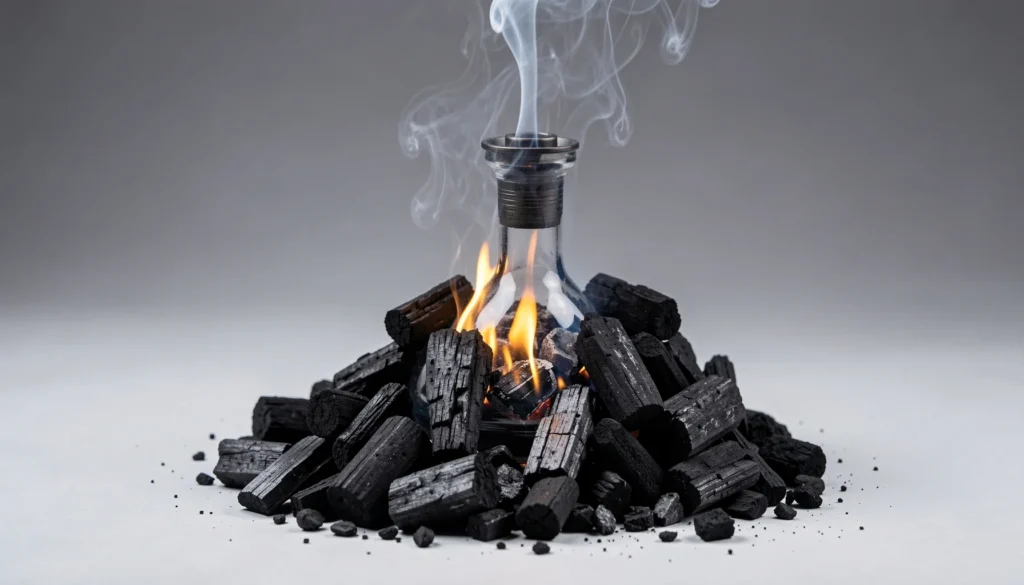
Charcoal moisture content affects shisha charcoal ignition and useful heat output because retained water must evaporate during heating. Damp briquettes may be slower to light, but moisture alone does not predict burn duration, ash content or suitability for a heat-management device. For wholesale buying, compare a product-specific moisture report with a representative sample tested in the intended setup, alongside relevant supplier quality benchmarks.
How Moisture Affects Shisha Charcoal
Charcoal can retain water after processing and absorb humidity during storage, making suitable charcoal packaging materials for export important for moisture protection. A dry-looking surface does not establish the moisture inside a briquette. FAO explains that charcoal absorbs atmospheric moisture and that evaporating this water reduces useful heating power. Its general charcoal guidance is not a shisha specification or a test result for KAOLA products.
Compare charcoal of the same formulation, dimensions and condition. Ignition also depends on volatile matter, density, burner output and airflow. Hissing, cracking or uneven heating are reasons to investigate, not proof of moisture content without measurement.
Moisture Is Not the Same as Ash
Laboratory ash content measures the inorganic residue remaining after the combustible material has been burned under the specified test conditions. Unburned carbon left during an operating test is not automatically mineral ash. Do not infer that moisture directly increases the product’s measured ash content or causes clinker formation. Evaluate ash composition, formulation and operating conditions separately.
Burn Duration Needs a Defined Test
There is no universal four-to-six-hour shisha burn specification in this guide. Piece size, formulation, airflow, heat-management device and replacement criteria affect useful operating time. A charcoal piece continuing to glow is not necessarily delivering the heat required by the user. Record the test conditions and the time until replacement is needed rather than copying a grilling-charcoal figure into a shisha quotation.
Coconut Shell Charcoal for Shisha: Product and Moisture Checks
For shisha enquiries, KAOLA recommends evaluating purpose-made coconut-shell briquettes in the required cube or round form. Raw coconut-shell lumps, sawdust grilling briquettes and Binchotan are not interchangeable with finished shisha charcoal. KAOLA does not recommend its Binchotan for this application.
Review KAOLA coconut shell charcoal product information, then confirm the available form, dimensions, binder or formulation, packing and representative sample with our team. A product page or raw-material photograph is not confirmation that a particular shisha SKU is currently available.
No fixed carbon percentage, calorific value or guaranteed burn duration is asserted for KAOLA shisha products in this guide. These must come from the applicable specification and identified sample or batch. Do not transfer White Eucalyptus Binchotan laboratory results to coconut-shell or sawdust products.
A Wholesale Buyer’s Moisture and Performance Checklist
Define the Acceptance Criteria
- Intended shisha setup and required cube or round dimensions.
- Raw material, binder or formulation requirements and acceptable size variation.
- Agreed moisture, ash, volatile matter and fixed-carbon targets with reporting basis.
- Calorific value with units such as kcal/kg or MJ/kg, specifying gross or net value and the sample basis.
- Ignition time, useful heat, replacement interval, breakage and ash-handling criteria under a written test procedure.
- Retail or bulk packing, private-label artwork, quantity and destination.
A moisture limit should be agreed for the specific product; the generic limits used for other charcoal applications are not automatically suitable for shisha briquettes.
Read the Actual Laboratory Report
Request the report number, laboratory, product identity, sample identifier, sampling and testing dates, method, result units and reporting basis. Check whether a production lot is identified. A representative sample report is not evidence that every shipment was tested. Any shipment-level testing or inspection must be agreed separately.
Test methods referenced by a laboratory are not company-wide certifications. Moisture, ash and fixed-carbon percentages may be reported on different bases, such as as-received or dry basis; compare like with like. An MSDS or SDS addresses safety and handling information and does not replace a moisture or performance test. See KAOLA’s documents and test-scope guidance.
Test a Representative Sample
- Record the product, sample or lot identifier, dimensions and storage history.
- Use the intended equipment according to its manufacturer’s instructions and appropriate safety controls.
- Keep burner output, charcoal quantity, device and airflow consistent between comparisons.
- Record ignition time, observable cracking, heat consistency, ash handling and time until replacement.
- Compare with an approved reference sample; investigate differences before committing to a bulk order.
Laboratory analysis and an operating test answer different questions. The report measures specified properties; the operating test evaluates performance in the buyer’s setup. Neither should be described as a universal performance guarantee.
Protect Charcoal from Moisture During Storage
Agree suitable moisture-resistant packaging and inspect the condition of seals, liners and cartons. Packaging reduces exposure but should not be described as completely moisture-proof without validation. Store according to the supplier’s safety instructions, under cover, away from water and damp floors, and follow the applicable fire-safety requirements.
- Inspect and record wet, torn or damaged packaging on arrival.
- Keep lot labels and packing records so affected cartons can be traced.
- Limit unnecessary exposure of opened packs to humid air.
- Separate suspect material for assessment and ask the supplier how to proceed.
Do not improvise oven drying, reheating or repacking of suspect charcoal. Charcoal handling and transport have safety requirements beyond moisture control. Required safety, origin, inspection and destination documents must be confirmed for the actual shipment; this guide does not establish customs clearance or document availability.
Troubleshoot Without Blaming Moisture Alone
Slow ignition can reflect moisture, density, volatile matter, insufficient burner output or restricted airflow. Breakage can reflect formulation, handling damage or thermal stress. Uneven heat can reflect dimensions, placement and device operation. Record symptoms, compare under controlled conditions and request appropriate testing instead of diagnosing a batch from appearance alone.
Low odor or limited visible smoke does not make charcoal combustion harmless. The CDC notes that charcoal used for hookah can produce carbon monoxide and other harmful emissions. Do not use this guide as a claim that shisha is safe; follow equipment instructions and applicable safety requirements, and never ignite charcoal in an enclosed or poorly ventilated space.
Discuss a Sample and Wholesale Requirement with KAOLA
Send the required shisha charcoal form, dimensions, formulation criteria, technical targets, packing, order quantity and destination. KAOLA will review the available product and representative sample before confirming an offer. Final specifications, inspection, documents, payment terms and production or loading schedule follow the agreed quotation and contract.
Send your charcoal requirements or review the wholesale and OEM enquiry process. No price, current stock or fixed delivery date is promised by this article.
Frequently Asked Questions
Can Charcoal Look Dry but Contain Moisture?
Yes. Appearance does not reliably establish internal moisture, and charcoal can absorb humidity after production. Use an applicable laboratory measurement and inspect packaging and storage history.
Does Low Moisture Guarantee a Long Shisha Session?
No. Moisture is one variable among formulation, dimensions, airflow and device operation. Agree an operating test and replacement criteria rather than a universal number of hours.
Does Moisture Increase Laboratory Ash Content?
Not directly. Ash is the inorganic residue measured under the test method. Moisture and reporting basis can affect percentage comparisons, while unburned carbon in use must not be confused with mineral ash.
Can KAOLA BBQ Briquettes or Binchotan Be Sold as Shisha Charcoal?
Not automatically. KAOLA does not recommend its Binchotan for shisha. Confirm a purpose-made coconut-shell product, available form and representative sample for the intended setup before preparing an offer.
Which Evidence Should a Wholesale Buyer Request?
Request the applicable specification, identified sample or batch report, agreed operating-test record, packing details and shipment-specific documents. A report for one sample or another product does not prove every lot meets the buyer’s requirements.
For the distinction between fuel families, read our shisha charcoal versus Binchotan buyer guide. When preparing an import enquiry, use the sourcing and traceability checklist for its evidence-review principles, not as proof that a coconut-shell product has the same supply chain or test results.
Sources and Scope
- FAO: Using charcoal efficiently — general explanation of moisture, fixed carbon and mineral ash, not a KAOLA or shisha product specification.
- Kaloud Aura product guidance — manufacturer example of purpose-made coconut charcoal and setup-dependent burn time, not evidence of KAOLA performance.
- CDC: Hookahs — health risks and emissions associated with charcoal-heated hookah.
This article provides purchasing guidance, not a laboratory certificate, safety certification or confirmation of product availability. Product and order details require KAOLA’s review.
For commercial comparisons, see the coconut-shell charcoal wholesale quote guide. Keep product form, net quantity, packing and delivery basis consistent alongside the moisture evidence.
